
What Is Dyno Tuning a Motorcycle? A Rider’s Complete Guide to Power Optimization
 Jake Miller
14 min read
Jake Miller
14 min read
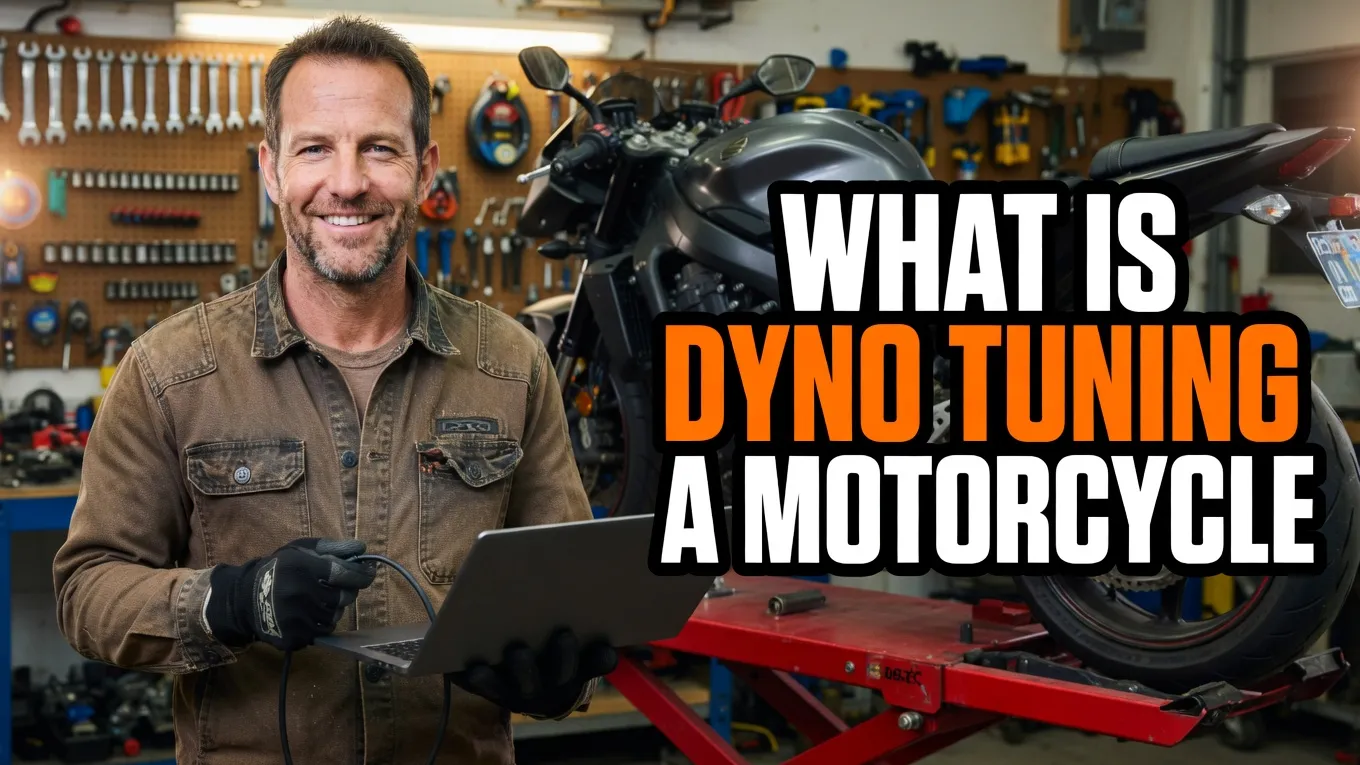
I’ll be honest—the first time someone mentioned dyno tuning my motorcycle, I had no idea what they were talking about. I’d heard the term thrown around at bike nights and seen the readouts posted on forums, but the actual process seemed like black magic reserved for racing teams and hardcore performance junkies.
After years of riding and modifying bikes, I’ve learned that dyno tuning isn’t just for racers. It’s one of the most valuable investments you can make if you’ve modified your motorcycle or want to unlock its true potential.
In this guide, I’m sharing everything I’ve learned about what dyno tuning actually is, why it matters, and whether your bike needs it.
- Dyno tuning optimizes your motorcycle’s fuel and ignition maps on a dynamometer to maximize performance and efficiency
- It’s essential after installing aftermarket exhausts, air filters, or other engine modifications
- Professional tuning costs $300-$1,200 depending on complexity but delivers measurable power gains and smoother running
- Stock bikes rarely need tuning, but modified bikes run dangerously lean without proper calibration
- The process involves multiple test runs with incremental ECU adjustments until optimal performance is achieved
Understanding the Basics: What Dyno Tuning Actually Means
Let me break this down in simple terms. A dynamometer—or “dyno” for short—is essentially a sophisticated treadmill for motorcycles. Your bike sits on rollers while the engine runs at various RPMs, allowing technicians to measure horsepower, torque, and other performance metrics under controlled conditions.
But here’s where it gets interesting: dyno tuning goes far beyond just measuring power. It’s the process of making precise adjustments to your motorcycle’s engine management system while the bike is on the dyno, testing those changes in real-time, and repeating the process until everything is optimized.
Think of it like tuning a guitar. You could play it out of tune and it’ll still make sound, but it won’t sound right. Your motorcycle’s engine is similar—it’ll run with factory settings even after modifications, but it won’t perform optimally and might even damage itself over time.
The Role of Your Motorcycle’s ECU
Modern motorcycles are controlled by an Electronic Control Unit (ECU)—basically a computer that manages fuel injection, ignition timing, and other engine parameters. The ECU uses “maps” (predetermined tables of values) to decide how much fuel to inject and when to fire the spark plugs based on throttle position, RPM, engine temperature, and other factors.
Factory maps are conservative compromises designed to work reasonably well across different conditions, altitudes, fuel qualities, and emission standards. They’re not optimized for your specific bike with your specific modifications in your specific environment.
That’s exactly what dyno tuning fixes. Modern systems like what is throttle by wire on a motorcycle make this process more precise but also more complex, requiring expert calibration to get right.
Why I Recommend Dyno Tuning: The Real Benefits
When I first had my Ducati tuned after installing a full exhaust system, I was skeptical about whether I’d actually feel a difference. The dyno sheet showed a 12-horsepower gain, but numbers on paper don’t always translate to the seat of your pants, right?
Wrong. The difference was immediately noticeable.
Improved Power and Throttle Response
The most obvious benefit is increased horsepower and torque. But honestly, the raw power gain isn’t what impressed me most. It was the smoothness of power delivery and how much crisper the throttle response became.
Before tuning, my bike had a slight hesitation when cracking the throttle open. After tuning, that was completely gone. The engine responded instantly to throttle inputs, making the bike feel more connected and predictable—especially important when you’re carving through canyon roads or need to accelerate out of a corner.
Optimal Air-Fuel Ratios
Here’s something that surprised me: motorcycles with aftermarket exhaust systems often run dangerously lean without proper tuning. When you increase airflow (with a less restrictive exhaust or high-flow air filter), the factory fuel maps don’t compensate adequately.
Running too lean means your engine isn’t getting enough fuel for the amount of air entering the cylinders. This creates excessive heat that can damage pistons, valves, and other internal components over time. I’ve seen engines destroyed because owners installed exhaust systems without tuning.
A proper dyno tune ensures your air-fuel ratio stays in the safe zone—typically around 13:1 to 13.5:1 for performance applications—protecting your engine while maximizing power.
Better Fuel Economy
This might sound counterintuitive, but properly tuned motorcycles often get better fuel economy than poorly tuned ones. When your engine runs efficiently with optimal fuel delivery, you’re not wasting gas on incomplete combustion or overly rich conditions.
I picked up about 3-4 MPG on my bike after tuning, which added up to real savings over thousands of miles. Just like choosing what is the best engine oil for 4 stroke motorcycle matters for longevity, proper fueling matters for efficiency.
Smoother Running and Reduced Heat
Before tuning, my bike would occasionally pop and backfire on deceleration—a common issue with bikes running lean. These symptoms disappeared after a proper tune. The engine also ran noticeably cooler, especially in traffic, because combustion was happening more efficiently.
When Your Motorcycle Actually Needs Dyno Tuning
Not every motorcycle needs dyno tuning. I’m not going to tell you it’s mandatory for every rider, because it’s not. But certain situations absolutely call for it.
After Installing Performance Modifications
If you’ve installed any of these modifications, dyno tuning isn’t optional—it’s essential:
Aftermarket exhaust systems are the most common reason riders seek tuning. Full systems, slip-ons, or even just removing baffles all change exhaust flow significantly. Your factory ECU has no idea you’ve made these changes and continues using the old fuel maps.
High-flow air filters or intake modifications increase the volume of air entering your engine. More air without proportionally more fuel equals a lean condition that can cause serious damage.
Engine modifications like big-bore kits, camshaft upgrades, or head porting completely change your engine’s breathing characteristics. Factory maps become essentially useless with these changes.
When Riding at Significantly Different Altitudes
Air density changes dramatically with altitude. If you live at sea level but frequently ride in the mountains (or vice versa), your bike’s performance suffers because the air-fuel mixture isn’t optimized for the thinner or denser air.
I rode from Los Angeles to Colorado once, and my bike felt noticeably down on power above 8,000 feet. A custom tune that accounts for your typical riding altitude makes a real difference.
If Your Bike Runs Poorly Despite Being Mechanically Sound
Sometimes older bikes develop running issues—rough idle, hesitation, poor throttle response—that aren’t caused by mechanical problems. In many cases, the ECU maps have simply degraded or were never optimized properly from the factory.
I’ve seen 10-year-old bikes transformed with a fresh tune, running smoother than they did when new.
When You DON’T Need Dyno Tuning
If your motorcycle is completely stock and running well, there’s generally no reason to tune it. Manufacturers spend millions optimizing factory maps, and they work well for unmodified bikes.
Similarly, minor modifications like adding frame sliders, mirrors, or cosmetic changes obviously don’t affect engine performance and don’t require tuning.
The Dyno Tuning Process: What Actually Happens
When I first took my bike in for tuning, I stayed at the shop to watch the entire process. It was fascinating to see how methodical and data-driven the process is.
Initial Assessment and Baseline Run
The tuner started by strapping my motorcycle securely to the dyno and performing a baseline power run. This measures your bike’s current horsepower and torque output across the entire RPM range without making any changes.
This baseline is crucial—it’s your “before” data that shows what gains you’re making and helps identify any existing problems. My baseline run revealed I was making about 8 horsepower less than expected, confirming my bike was running poorly.
ECU Connection and Map Analysis
Next, the tuner connected a laptop to my bike’s ECU using specialized software and cables. They pulled the current fuel and ignition maps to see what the ECU was doing at various throttle positions and RPM ranges.
Modern throttle by wire systems add another layer of complexity here, as they also include throttle position maps that affect how the bike responds to your right wrist inputs.
Incremental Adjustments and Testing
Here’s where the real work begins. The tuner makes small adjustments to the fuel map in specific RPM and throttle position cells, then runs the bike on the dyno to see how those changes affect power output, air-fuel ratio, and engine temperature.
This process is repeated dozens—sometimes hundreds—of times. Each adjustment is tested, data is analyzed, and further refinements are made. It’s painstaking work that requires experience, skill, and patience.
Good tuners don’t just chase peak horsepower numbers. They’re looking at the entire powerband, ensuring smooth power delivery, safe air-fuel ratios throughout the RPM range, and proper ignition timing that won’t cause detonation.
Final Verification and Road Testing
Once the tuner is satisfied with the dyno results, they’ll typically take the bike for a test ride. The dyno provides a controlled environment, but real-world riding conditions include factors like wind resistance, varying loads, and transient throttle inputs that can’t be perfectly replicated on rollers.
After the test ride, minor adjustments might be made before the final map is flashed permanently to your ECU.
Understanding the Costs: What You’ll Actually Pay
Dyno tuning isn’t cheap, but it’s not outrageous either when you consider what you’re getting. I’ve paid for several tunes over the years on different bikes, and the pricing has been fairly consistent.
Basic Tuning Services
A straightforward dyno tune for a bike with a slip-on exhaust and air filter typically runs $300-$600. This includes baseline runs, map adjustments, final verification, and usually a printout of your before-and-after dyno charts.
The session takes 2-4 hours depending on the bike’s complexity and how much adjustment is needed.
Complex Performance Builds
If you’ve done extensive modifications—full engine builds, forced induction, exotic fuel systems—expect to pay $800-$1,200 or more. These tunes require significantly more time and expertise.
I paid nearly $1,000 for a tune after installing a big-bore kit and cams on my old Sportster, but it took the tuner over 6 hours to dial everything in perfectly. Worth every penny for the peace of mind that my expensive engine work wasn’t going to grenade itself.
Additional Costs to Consider
Some shops charge separately for dyno time versus actual tuning services. You might pay $100-$150 just for baseline dyno runs, then additional fees for the tuning work itself.
If your bike needs a Power Commander, fuel controller, or ECU flash to enable tuning, that’s an additional cost. Power Commanders typically run $300-$400 plus installation, while ECU flash services range from $200-$400.
Don’t forget about the underlying maintenance needs either. Just like you’d research what is the best 2 cycle oil for a motorcycle engine or what is the best engine oil for motorcycle racing for proper maintenance, you need clean oil and proper engine health before tuning.
Finding a Quality Dyno Tuner: What I Look For
Not all dyno shops are created equal. I’ve had both excellent and mediocre tuning experiences, and the difference comes down to the tuner’s skill and approach.
Experience with Your Bike Type
Find someone who regularly tunes your make and model. A tuner who specializes in Harleys might not be the best choice for your sport bike, and vice versa. Each platform has quirks and common issues that experienced tuners know how to handle.
I always ask how many bikes like mine they’ve tuned. If the answer is “yours will be the first,” I’m probably going elsewhere unless they come highly recommended for their general expertise.
Reputation and References
Check online reviews, ask on local riding forums, and see what bikes are parked outside the shop. A good tuning shop will have a steady stream of customers and strong word-of-mouth reputation.
Don’t be shy about asking for references or examples of previous work. Quality tuners are proud to show you dyno charts from similar builds.
Their Philosophy on Tuning
Be wary of tuners who promise unrealistic power gains or only focus on peak horsepower numbers. Good tuners prioritize reliability, smooth power delivery, and safe air-fuel ratios over chasing bragging rights.
When I interviewed tuners for my Ducati, one shop promised “at least 20 horsepower gains guaranteed.” Another said, “I’ll optimize what you’ve got and prioritize reliability—probably 10-15 horsepower if everything goes well.” Guess which one I chose? The realistic one, and he delivered excellent results.
Alternatives to Dyno Tuning: When They Make Sense
Dyno tuning is the gold standard, but it’s not the only option for improving your bike’s performance.
Pre-Made Map Files
Many exhaust manufacturers provide downloadable ECU maps designed specifically for their products. These “canned” maps work reasonably well for common modifications and are much cheaper than custom dyno tuning—often free or under $100.
I’ve used manufacturer maps on bikes with simple modifications, and they’re definitely better than running stock maps with aftermarket parts. But they’re still compromises that can’t account for your specific bike, altitude, fuel quality, or riding style.
Auto-Tuning Fuel Controllers
Devices like the Dynojet AutoTune system or Bazzaz Z-AFM make automatic adjustments to fuel delivery based on oxygen sensor feedback while you ride. They essentially tune your bike continuously in real-world conditions.
These work surprisingly well for mild builds but can’t match a proper dyno tune for heavily modified engines. I see them as a good middle ground—better than nothing, not as good as professional tuning.
Street Tuning with a Laptop
Some experienced riders tune their own bikes using laptop software and wideband oxygen sensors while riding. This “street tuning” approach can work but requires significant technical knowledge and is time-consuming.
It’s also somewhat risky—you’re essentially experimenting with fuel and ignition settings while riding, which could cause engine damage if you make the wrong adjustments.
Maintaining Your Tune: Long-Term Considerations
Once you’ve invested in dyno tuning, you want that optimized performance to last. Here’s what I’ve learned about keeping my bikes running well after tuning.
Regular Maintenance Is Critical
A proper tune assumes your engine is in good mechanical condition. If you let maintenance slide—dirty air filters, old spark plugs, contaminated fuel—your bike won’t perform as the tune intended.
I’m religious about oil changes using what is the best oil for a harley davidson motorcycle for my Harley, quality synthetic for my sport bikes, and fresh spark plugs every season. Your tune can only work with the hardware you give it.
When to Retune
You’ll need a new tune whenever you make significant modifications—adding or changing exhaust components, air filters, or engine internals. Minor changes might not require a full retune, but major ones definitely do.
I also recommend retuning every few years even without modifications. ECU software can degrade slightly over time, and parts wear affects how your engine breathes.
Seasonal Adjustments
Temperature and humidity affect air density, which impacts your tune’s effectiveness. Some riders with aggressive builds have summer and winter maps they swap between, though this is overkill for most street bikes.
My bikes run slightly rich in winter (when cold air is denser) and slightly lean in summer, but the difference is minor enough that I don’t bother changing maps seasonally.
My Final Take on Dyno Tuning
After years of riding both tuned and untuned motorcycles, I’m convinced that proper dyno tuning is one of the best investments you can make—if your bike actually needs it.
For modified bikes, it’s not optional. The performance gains, engine protection, and improved rideability easily justify the cost. I genuinely enjoy riding my tuned bikes more than I did before optimizing them.
For stock bikes, save your money. Manufacturers do a good job with factory maps, and you won’t see meaningful benefits from tuning an unmodified motorcycle.
If you’re on the fence, start by evaluating whether your bike runs properly. Does it hesitate, backfire, run hot, or feel down on power? If yes, tuning might reveal and fix underlying issues. If your bike runs great, you probably don’t need it.
The key is finding a knowledgeable tuner who prioritizes reliability over peak numbers and takes the time to dial in your specific bike. That’s what separates a transformative tuning experience from a disappointing one.
When done right, dyno tuning doesn’t just make your bike faster—it makes it better in every way that matters.
Frequently Asked Questions
What exactly is dyno tuning for motorcycles?
Dyno tuning is the process of optimizing your motorcycle’s fuel and ignition maps on a dynamometer (dyno) to maximize performance, improve throttle response, and ensure your engine runs efficiently with any modifications you’ve made.
How much does motorcycle dyno tuning typically cost?
Professional dyno tuning usually costs between $300-$600 for a basic tune, though complex builds or performance tunes can run $800-$1,200 or more depending on your location and the shop’s expertise.
Do I need dyno tuning if my motorcycle is stock?
Stock motorcycles generally don’t need dyno tuning since manufacturers optimize them at the factory. However, if you’ve added an aftermarket exhaust, air filter, or other performance modifications, dyno tuning becomes important to maintain proper air-fuel ratios.
What’s the difference between a power run and actual dyno tuning?
A power run simply measures your bike’s current horsepower and torque output. Actual dyno tuning involves making incremental adjustments to your ECU’s fuel and ignition maps, then testing those changes repeatedly until optimal performance is achieved.

Related Articles
7 Best Batteries for Motorcycles I’ve Tested and Trust in 2026
I've tested dozens of motorcycle batteries to find the best performers. From AGM to lithium, here are my top picks…
Jake Miller
15 min read

The Perfect Battery for Your Harley Davidson Softail: A Rider’s Complete Guide
Discover the perfect battery for your Harley Davidson Softail. I've tested multiple options and share real-world performance data, maintenance tips,…
Jake Miller
14 min read

The Best Battery for Your Harley Davidson: My Complete Guide After Years of Testing
Discover which battery truly performs best for Harley Davidson motorcycles. Real rider experience with AGM, lithium, and OEM options to…
Jake Miller
12 min read