
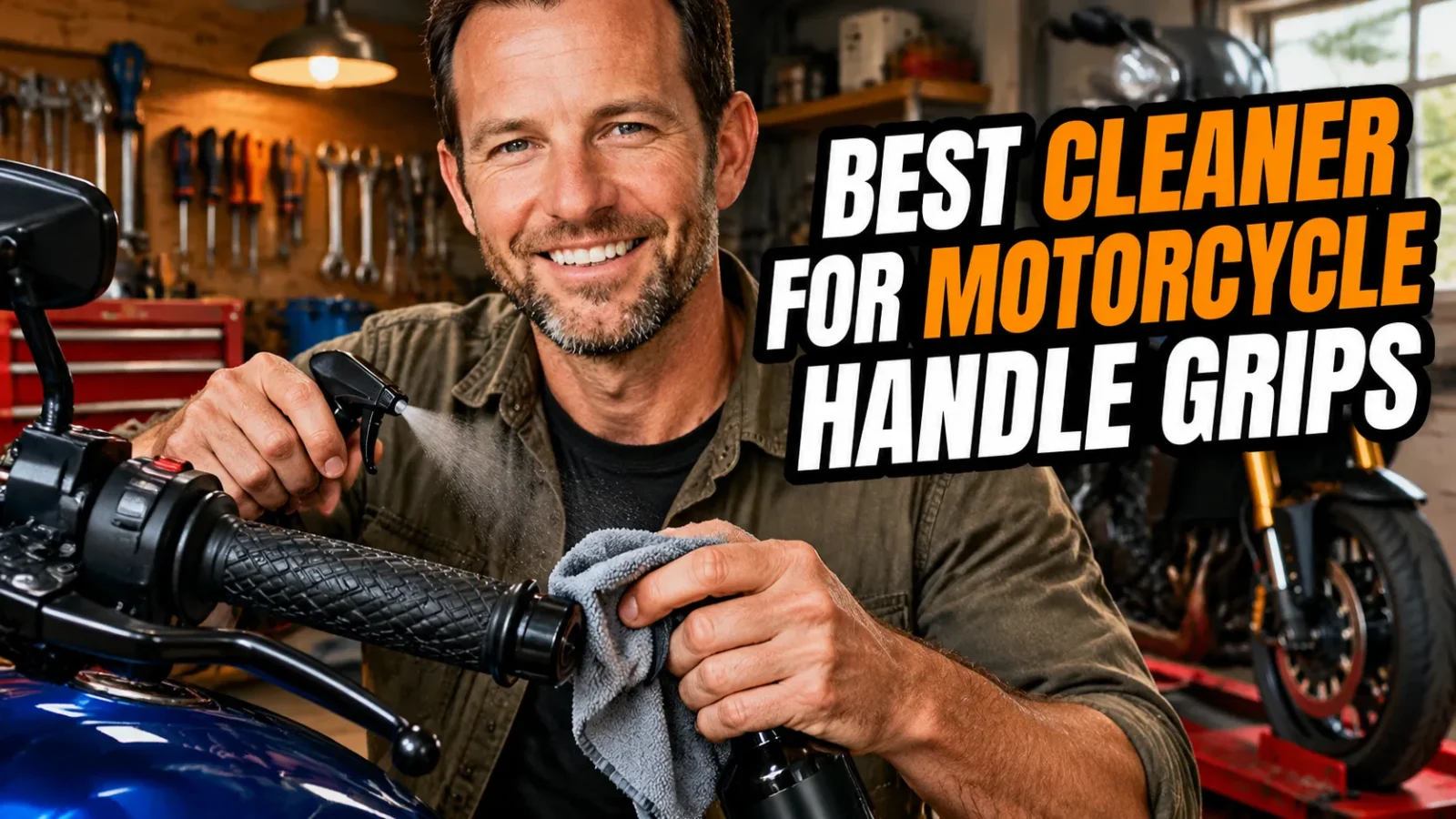
I’ve melted a set of grips with the wrong cleaner, and I’ve spent far too many evenings scrubbing chain lube out of half-worn rubber with nothing but a rag and plain water. Both lessons taught me the same thing: grips are a soft, sacrificial wear item, and what you clean them with matters as much as how often you clean them.
Over the last few seasons I’ve run eight different cleaners across my ADV bike, my dirt bike, and a couple of borrowed cruisers. Some are pro-grade detailing products, some are hardware store staples, and one is a nine-dollar bottle I keep re-buying because it simply works. Here’s what I actually use, what I’d skip, and why.
One thing I’ve figured out the hard way is that hand comfort is a system. Grips, bar position, and your Best Motorcycle Seat all work together, and a slippery grip on a bad seat makes a two-hour ride feel like a six-hour one. Clean, tacky rubber is where that chain starts.
- My overall pick is Meguiar’s M40 because it cleans and conditions rubber in one step without leaving grips slick.
- Chemical Guys All Clean+ is the best value if you want one bottle that does the whole bike and dilutes down.
- Avoid solvent-based cleaners, brake cleaner, and greasy silicone dressings. They harden or slick up grip rubber fast.
- Always rinse and dry fully. Residue, not the cleaner itself, is what usually ruins the feel of a grip.
1. Meguiar’s M40 Mirror Glaze Vinyl & Rubber Cleaner/Conditioner — Best Overall
If I only kept one bottle in the garage for grips, it would be this one. Meguiar’s M40 comes out of the company’s professional Mirror Glaze line, which is the same family of products body shops use, and it’s formulated specifically for vinyl, rubber, and plastic rather than being a generic all-purpose spray.
What I love is that it cleans and conditions in a single step. The water-based formula lifts the grey oxidized film that builds up on grip rubber, then leaves behind UV blockers and a satin finish instead of a wet, greasy shine. That satin finish is the whole point, because a glossy grip is a slippery grip.
How I use it
I spray M40 onto a microfiber applicator rather than directly onto the grip, work it into the rubber, let it sit for about thirty seconds, then buff everything dry with a clean towel. If you leave it wet, it will feel slick for a few minutes, so the buffing step is not optional.
A 16-ounce bottle runs somewhere around $11 to $15 at most auto parts stores, and I get a full season out of it easily. It’s also brilliant on footpeg rubbers, brake and clutch lever boots, and the rubber bits on your mirrors, so it earns its shelf space.
2. Chemical Guys All Clean+ Citrus Based APC — Best Value and Most Versatile
All Clean+ is the bottle I reach for when the grips are genuinely filthy, not just dusty. It’s a citrus-based all-purpose cleaner and degreaser, and because it’s concentrated, one 16-ounce bottle mixed down makes gallons of working solution.
My dilution routine is simple: roughly 10:1 for light dust and fingerprints, 4:1 for normal road grime, and 1:1 for the caked-on mess after a rainy week of commuting. At 1:1 it will cut through chain lube overspray that has migrated onto your left grip, which is a real problem on chain-driven bikes.
It’s safe on rubber, vinyl, and plastic, which is why I trust it around the switchgear and control housings. The citrus scent is strong but not unpleasant, and it rinses clean without leaving a film, which is the number one thing I care about on a grip surface.
This is also the product I recommend to riders who are still sorting out their cockpit. If you’re shorter and fighting reach, pairing clean, tacky grips with a Best Motorcycle Seat for Short Riders changes how much weight you’re putting through your palms, and suddenly grip texture matters a lot less than it did.
3. S100 Total Cycle Cleaner — Best Spray-and-Rinse Motorcycle Cleaner
S100 is the classic German spray-on, hose-off motorcycle cleaner, and it’s the one I keep for lazy Sunday afternoons. You mist it on, let it dwell for a few minutes, agitate the nasty bits, and rinse. No bucket, no scrubbing the whole bike by hand.
The formula is a clinging gel rather than a thin spray, so it stays where you put it instead of running straight off the grips and onto the ground. It’s biodegradable and safe on paint, chrome, rubber, and plastic, which means I can spray the bars, the grips, the levers, and the mirrors in one pass.
A one-liter bottle runs around $16 to $20 and lasts me most of a season. My only caution is that it’s not a heavy degreaser, so if your grips are coated in chain lube or fork oil, step up to an APC first and finish with S100.
4. Spray Nine Heavy Duty Cleaner — Best for Caked-On Dirt Bike Grime
Spray Nine is the secret weapon of the off-road crowd, and I understand why. It’s a heavy-duty cleaner, degreaser, and disinfectant that comes in a 32-ounce trigger bottle for under $12, and it laughs at dried mud, dust, and premix residue.
On my buddy’s best motorcycle seats for kawasaki klx250 build, the grips were permanently coated in a grey film of trail dust and grip glue. Two passes with diluted Spray Nine and they looked nearly new again.
Here’s the honest caveat: Spray Nine is aggressive, and if you leave it sitting on rubber it can dry the surface out over time. I dilute it about 50/50 with water for grips, let it dwell for a minute at most, then rinse thoroughly. Do that and it’s a fantastic tool.
5. Muc-Off Nano Tech Motorcycle Cleaner — Best pH-Neutral Eco Option
Muc-Off’s pink Nano Tech cleaner is pH neutral, water-based, and biodegradable, and it’s the product I reach for when I’m cleaning in the driveway and don’t want runoff heading toward the storm drain. It’s the safest general-purpose cleaner on this list for rubber and plastic.
Because it’s pH neutral, it won’t degrade the grip compound the way an alkaline or acidic cleaner can over repeated use. That matters more than people think, because grip rubber is soft and porous, and repeated chemical attack is what turns a tacky grip into a hard, shiny one.
A one-liter bottle runs about $18 to $22, and Muc-Off also sells a concentrate and a pre-mixed pressure sprayer version that’s genuinely convenient for the whole bike. On grips specifically, I spray, agitate with a soft brush, then rinse and dry.
6. Simple Green All-Purpose Cleaner — Best Budget Pick
Simple Green is the bottle that’s probably already under your kitchen sink, and it does a perfectly respectable job on grips when you dilute it properly. A 32-ounce concentrate costs around $8 and makes multiple gallons of working solution.
I mix it roughly 10:1 with water for grips, scrub with a soft brush, and rinse thoroughly. It’s non-toxic and biodegradable, so I never worry about it around the garage or the kids.
The one rule I never break: keep Simple Green away from bare aluminum and anodized surfaces. The manufacturer says so, and I’ve seen fork lowers and engine cases go cloudy from it. Your grips and plastic switchgear are fine; your polished aluminum is not.
It’s also a reminder that comfort is a package deal. Tall riders in particular end up leaning on the bars more than they should, and a Best Motorcycle Seat for Tall Riders often fixes the numb-palms problem better than any grip swap will.
7. Maxima SC1 Clear Coat Spray — Best Finishing Detail Spray
SC1 is the product dirt riders call “new bike in a can,” and it’s technically a detail spray rather than a cleaner. I use it as the last step after cleaning, never as the first.
It’s a silicone-based clear coat spray that restores black to faded rubber and plastic and leaves a dry, non-greasy finish. On grips, a light mist and a buff brings back the deep black look and makes mud and dust slide off instead of embedding in the texture.
A 12-ounce can runs about $12 to $15. The key is restraint. One light pass is plenty. Soak the grip and you’ll be wiping silicone off your gloves for the next three rides, and that is exactly the slippery feeling you’re trying to avoid.
8. Optimum Power Clean — Best Pro-Grade Water-Based APC
Optimum Power Clean is the product I graduated to once I started caring more about what’s actually in the bottle. It’s a water-based all-purpose cleaner with no butyl or harsh solvents, and it’s safe on rubber, vinyl, plastic, and even leather.
It dilutes roughly 3:1 for general use, which makes a 32-ounce bottle last a very long time at around $18 to $20. On grips, I spray it on a microfiber, agitate, wipe, then follow with a damp cloth to remove residue.
The reason I rate it so highly is control. It cleans aggressively enough to strip chain lube and bug splatter, but it rinses clean and doesn’t leave the rubber feeling chalky or dried out. For a daily rider, that balance is everything.
How I Actually Clean My Grips
My routine takes about five minutes and hasn’t let me down yet. First, I rinse the bars with plain water to knock off loose dust, because scrubbing dry grit into rubber is basically sanding it.
Next, I apply my cleaner of choice to a microfiber applicator or a soft detailing brush, never a stiff bristle brush, and work it into the grip in a circular motion. Then I rinse thoroughly with low-pressure water and dry with a clean microfiber towel.
Finally, if the grips look faded, I finish with a light coat of M40 or SC1 and buff everything dry. Dry is the operative word. Any wet residue left on the rubber is what makes grips feel greasy for the next hundred miles.
What I Never Put on Grips
Brake cleaner, carb cleaner, and contact cleaner are all off the table. They’re solvent-based, and they will pull the plasticizers straight out of the rubber, leaving you with hard, shiny grips that feel like polished stone.
I also avoid greasy dressings and tire shine style products. Anything that leaves a wet gloss is a safety issue on a control surface, and I’ve watched riders do this and then complain that their grips feel dangerous in the rain.
And I don’t soak grips in undiluted APC and walk away. Dwell time matters. A minute is plenty for most products, and rinsing thoroughly is more important than the brand on the label.
Grips Are Only Half the Comfort Equation
Cleaning your grips is the cheap half of the fix. The expensive half, and honestly the one that changes your riding day more, is your seat. If your palms go numb and your grips are spotless, the problem is usually your posture, not your rubber.
Cruiser riders in particular benefit from this. If you’re logging big miles, a best motorcycle seat for harley touring will do more for your hands than any grip swap, simply because it stops you from bracing against the bars. Same story on a Best Seat for Harley Sportster, where a better perch takes weight off your wrists almost immediately.
So here’s my honest order of operations. Clean and condition your grips with something rubber-safe, set your lever angles correctly, and then fix your seat if your hands are still complaining. Do those three things and you’ll ride longer, with less fatigue, on any bike you own.
Frequently Asked Questions
What is the best cleaner for motorcycle handle grips?
For most riders, Meguiar’s M40 Vinyl and Rubber Cleaner/Conditioner is the best all rounder because it cleans and conditions rubber in one step. If your grips are really grimy, a diluted all purpose cleaner like Chemical Guys All Clean+ lifts the crud first.
Can I use dish soap to clean my grips?
You can, and it works in a pinch, but dish soap strips the natural oils out of rubber over time and leaves grips feeling chalky. A dedicated rubber safe cleaner or a diluted APC is much gentler on the compound.
Will cleaning my grips make them slippery?
Only if you use the wrong product. Solvent based cleaners and greasy silicone dressings leave a slick film behind. Stick to water based cleaners, rinse well, and buff everything dry so the rubber stays tacky.
How often should I clean motorcycle handle grips?
I wipe mine down after every couple of rides and give them a proper clean about once a month. If you ride dirt, clean them after every ride, because dust and mud act like sandpaper on soft rubber.

Related Articles

Rusty Bolt Rescue: How I Remove Rust from Motorcycle Bolts Without Snapping Them
Rusty motorcycle bolts? Here's how I remove rust from motorcycle bolts safely, from penetrating oil soaks to vinegar baths, plus…
 Jake Miller
11 min read
Jake Miller
11 min read

How to Properly Tie Down a Motorcycle: A Rider’s Field Guide to Straps, Anchors, and Zero Regrets
Learn how to properly tie down a motorcycle from a rider who has done it hundreds of times. Straps, anchor…
Jake Miller
10 min read

Basic Motorcycle Maintenance: My Honest Daily, Weekly, and Monthly Routine
I've spent years wrenching in my own garage. Here's my honest, no-nonsense guide to basic motorcycle maintenance, from daily checks…
Jake Miller
8 min read