
8 Best Motorcycle Tires for Traction: My Picks for Dry, Wet, and Rough Roads
 Jake Miller
8 min read
Jake Miller
8 min read
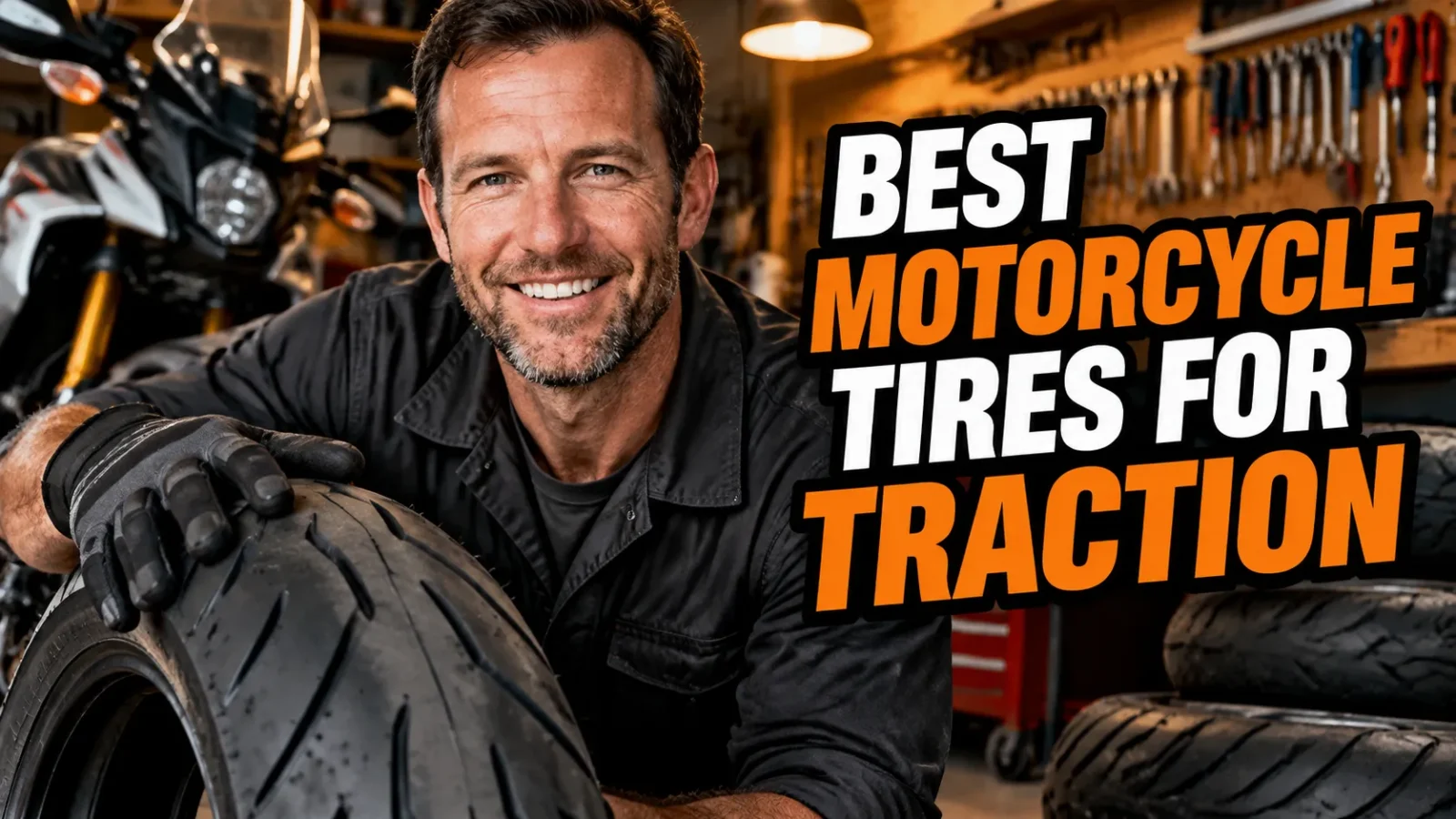
I’ve spent a lot of years obsessing over the two hand-sized patches of rubber that hold me to the road. A suspension upgrade or a fancy exhaust won’t save you when the front end starts to push in a wet corner. A good set of tires will.
Traction isn’t one thing, though. Grip on a warm, dry canyon road is a different problem from grip on a cold, rain-slicked commute or a gravel fire road. So I’ve picked the best option for each situation, based on my own miles and the trade-offs I’ve noticed.
- The Michelin Pilot Road 5 is my best all-round pick for wet and dry street traction.
- For dry-weather sport riding, the Pirelli Diablo Rosso IV and Bridgestone Battlax Hypersport S22 are hard to beat.
- Cruiser riders should look at the Michelin Commander III, and adventure riders at the Pirelli Scorpion Trail II.
- Even the best tire needs correct pressure, fresh rubber, and a healthy front end to deliver its grip.
How I Judged Traction
I looked at four things: dry grip, wet grip, how quickly the tire comes up to temperature, and how predictable it feels at the limit. A tire that grips hard but gives no warning before it lets go is worse than one with a bit less grip that communicates clearly.
I also weighed longevity and price. Traction that’s gone after 3,000 miles isn’t great value for most riders. Where I quote prices, treat them as rough ranges, because they vary by size and retailer.
1. Michelin Pilot Road 5 — Best All-Round Street Traction
If I could only recommend one tire to a typical street rider, it would be the Michelin Pilot Road 5. It’s a sport-touring tire built around Michelin’s XST+ sipe technology, which channels water out of the contact patch very effectively. The rear uses a dual-compound construction with a harder center for mileage and softer shoulders for lean-angle grip.
Why I Like It
In the wet, the Pilot Road 5 is the most confidence-inspiring street tire I’ve ridden. It also works at lower temperatures, so cold-morning rides don’t feel sketchy. Expect to pay roughly $150 to $230 per tire depending on size, which is fair for what you get.
Where It Falls Short
It won’t match a dedicated sport tire for outright dry grip on a hot track day. But on the road, I rarely miss that last few percent. If you like Michelin’s sporty side, my guide to the best micheline sport tire for motorcycle covers the more aggressive options.
2. Pirelli Diablo Rosso IV — Best Sport Tire for Spirited Road Riding
The Pirelli Diablo Rosso IV is the tire I reach for when the road gets twisty and the weather is cooperative. Pirelli designed it for sport bikes and powerful nakeds, with a profile that turns in quickly and a multi-compound rear that keeps grip as you lean over.
My Experience
What I love is how quickly it warms up. You don’t need a long ride to find its grip. Feedback through the bars is clear, so you know exactly how much is left in reserve.
It’s priced around $170 to $260 per tire. Mileage is moderate, so expect to replace it sooner than a touring tire. That’s the price of stickiness.
3. Bridgestone Battlax Hypersport S22 — Best for Dry-Weather Sport Grip
The Bridgestone Battlax Hypersport S22 is the tire I’d choose if I rode mostly dry roads and the occasional track day. It’s the successor to the well-liked S21, with a dual-compound rear that is tuned for strong grip at full lean.
Standout Traits
The S22 is stable and predictable, even when I’m pushing hard on bumpy pavement. It gives a planted feeling on corner exit, which is exactly where traction matters most when you’re getting back on the throttle.
Pricing is typically in the $160 to $250 range per tire. Wet performance is good for a sport tire, though it isn’t a match for the Pilot Road 5 when it’s pouring.
4. Dunlop Roadsmart IV — Best for Sport-Touring Mileage and Wet Grip
The Dunlop Roadsmart IV is a smart pick if you cover big miles but still want a bike that carves. Its rear tire uses Dunlop’s multi-tread design, which pairs a durable center with a grippier shoulder.
Why It Earns a Spot
I’ve found the Roadsmart IV very consistent in changing conditions. It’s especially good on wet roads, and it stays stable under load, which makes it a favorite for riders with luggage or a passenger. Expect roughly $140 to $220 per tire.
It feels slightly less razor-sharp than the Rosso IV on turn-in. But for riders who value long life and dependable grip over outright sportiness, the trade is worth it.
5. Michelin Commander III — Best Cruiser Tire for Traction
Cruisers have always been tough on tires, with heavy weight and torque. The Michelin Commander III addresses that with a dedicated cruiser and touring construction and a tread pattern designed for better wet grip than older cruiser rubber.
What To Know
On my cruiser, the Commander III feels stable and planted in sweeping corners, and it handles rain better than I expected. Prices run roughly $130 to $220 per tire, depending on size.
No tire is perfect, though. Some owners report quirks with wear or ride feel, which I covered in detail in my write-up on michelin commander 3 problems. Read that before you buy so you know what to watch for.
6. Pirelli Scorpion Trail II — Best for Adventure Bikes on Pavement
Big adventure bikes spend most of their time on asphalt, even if they look ready for the Dakar. The Pirelli Scorpion Trail II is built for exactly that, with a road-biased tread that still tolerates gravel and dirt roads.
Traction Character
The Scorpion Trail II grips well on dry and wet tarmac, which makes it a great match for heavy ADV machines. It’s available in common adventure sizes, such as 19-inch fronts and 17-inch rears. Expect to pay around $160 to $250 per tire.
If your bike has spoked wheels, you might wonder about safety. I addressed that concern in my article on are spoked motorcycle wheels dangerous, and the short answer is that they’re fine when properly maintained. Check the tire type carefully, since some sizes are tube-type.
7. Shinko 705 — Best Budget Dual-Sport Tire for Mixed Surfaces
Not everyone has $400 to spend on a pair of tires. The Shinko 705 is a well-known budget dual-sport tire with a block tread that bites into loose surfaces while still being usable on pavement.
The Honest Trade-Offs
On dirt and gravel, the Shinko 705 gives real traction for the price, often around $70 to $130 per tire. On wet pavement, I’m more cautious. It doesn’t have the sophisticated compounds of the premium options, so I ride more conservatively in the rain.
For a light dual-sport that sees a lot of trails, I think it’s a sensible choice. For a fast road bike, I’d spend more.
8. Continental ContiRoadAttack 4 — Best for Sport-Touring Versatility
The Continental ContiRoadAttack 4 rounds out my list as a strong all-rounder that sits between sport and touring. Continental built it with a focus on wet-road performance and stable handling across a wide range of bikes.
Why I Include It
It warms up quickly and offers dependable grip on dry roads, with good braking confidence in the wet. It’s often priced around $150 to $240 per tire. Riders who want an alternative to the usual Michelin or Pirelli choices should give it a look.
The sidewall stiffness feels a touch more rigid than some rivals, which I like for precision. Others may prefer a softer feel.
How To Get The Most Traction From Any Tire
Even the best tire will disappoint if you neglect the basics. I check my pressures cold before every ride, because a few PSI off changes the contact patch and the way the bike turns. I always follow the manufacturer’s recommended pressure for my bike and load.
Tire age matters, too. Rubber hardens over time, even if the tread looks good. I check the date code on the sidewall and replace anything much past five or six years old.
Don’t Ignore The Front End
Your front tire does most of the cornering work, so it’s worth understanding why it’s built the way it is. If you’re curious, I explain why is the front wheel bigger on motorcycle designs in a separate article.
If your front end shakes or shimmies, don’t blame traction first. Worn bearings, an unbalanced wheel, or an out-of-round tire can all cause it. My breakdown of why does my front wheel wobble on my motorcycle will help you diagnose it.
Break Them In Properly
New tires have a slick mold-release coating on the surface. I always ride gently for the first 100 miles or so, building lean angle gradually. It’s a small habit that has saved me from more than one unpleasant surprise.
Which Tire Should You Choose?
My advice is to match the tire to the riding you actually do, not the riding you imagine. If you commute and tour in all weather, the Michelin Pilot Road 5 or Dunlop Roadsmart IV will serve you best. If you chase corners on dry weekends, the Pirelli Diablo Rosso IV or Bridgestone Battlax Hypersport S22 will reward you.
Cruiser riders should start with the Michelin Commander III. Adventure riders will do well with the Pirelli Scorpion Trail II, while budget-minded dual-sport riders can save money with the Shinko 705.
Whatever you pick, buy fresh rubber, set the pressure properly, and give yourself time to learn the tire. Good traction is a partnership between the tire and the rider, and the best choice is the one that helps you ride with confidence.
Frequently Asked Questions
What motorcycle tire has the best overall traction?
For mixed street riding, I rate the Michelin Pilot Road 5 highest because it balances dry grip, wet grip, and mileage. For pure dry sport riding, the Bridgestone Battlax Hypersport S22 and Pirelli Diablo Rosso IV are my top choices.
How often should I replace motorcycle tires for the best traction?
Replace tires when the tread reaches the wear indicators, when the rubber is cracked or hardened, or at roughly five to six years of age. Traction drops well before a tire is visibly bald, especially in the wet.
Does tire pressure affect motorcycle traction?
Yes. Too low and the tire overheats and squirms. Too high and the contact patch shrinks. Check pressure cold before every ride and follow your bike’s manual, not the number on the sidewall.
Are sport tires or touring tires better for traction?
It depends on the conditions. Sport tires generally give more grip in warm, dry weather but wear faster and need heat. Sport-touring tires give up a little peak grip in exchange for better wet performance, longer life, and more consistency in cool temperatures.

Related Articles

8 Best Cruiser Motorcycle Tires for Street Riding: My Real-World Picks
I rank the 8 best cruiser motorcycle tires for street riding, from Michelin to Pirelli, with real notes on grip,…
Jake Miller
9 min read

8 Best Michelin Motorcycle Tires for Every Riding Style (Tested Picks)
Looking for the best Michelin motorcycle tires? I break down my 8 favorite models for sport, touring, adventure, cruiser, and…
Jake Miller
9 min read

Yamaha Tire Pressure Guide: The Right PSI for Safer, Smoother Rides
Learn the right tire pressure for your Yamaha, from sportbikes to cruisers and dirt bikes. Check, adjust and maintain PSI…
Jake Miller
9 min read