
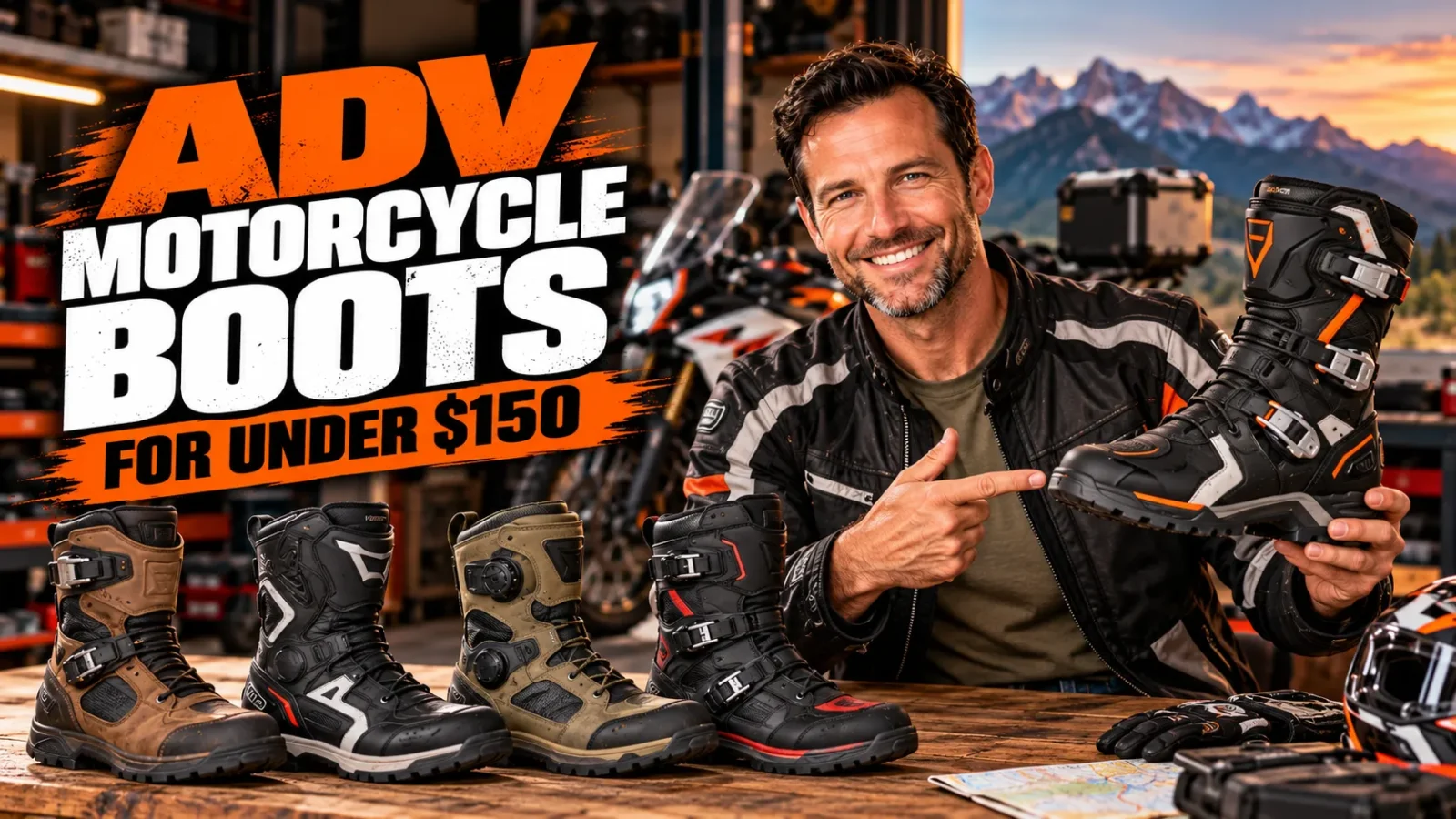
I’ve burned through a lot of boots chasing gravel roads and fire trails on a budget. Adventure riding is brutal on gear, and I learned early that you don’t need to spend $400 to get boots that actually protect your ankles and shins.
Over the past few seasons, I’ve worn, abused, and occasionally crashed in a stack of budget-friendly ADV boots. Some surprised me. Others taught me exactly why cheap boots get a bad reputation.
This list is my honest rundown of the best adv motorcycle boots for under 150 that I’d actually recommend to a riding buddy. If you want the bigger picture on boot construction, armor ratings, and materials first, my Ultimate Guide to Motorcycle Boots is a great place to start.
- My top overall pick under $150 is the Alpinestars Andes v2 Drystar for its waterproof liner and solid ankle protection.
- If you want the cheapest entry point that still holds up, the Bilt Voyager Adventure is tough to beat.
- For real off-road abuse, the Moose Racing Ridge ADV has the most aggressive sole and shifting pad.
- None of these will match a $400 race boot’s protection, but all pass basic CE testing and are legit daily-riding boots.
- Fit matters more than price. Try boots on with your actual riding socks before committing.
1. Alpinestars Andes v2 Drystar — Best Overall Value
The Alpinestars Andes v2 Drystar is the boot I keep recommending to friends who ask me where to start. Alpinestars is one of the most trusted names in the industry, and even their entry-level ADV boot punches above its price tag.
It uses a full-grain leather and textile upper with a Drystar waterproof, breathable liner. I’ve ridden through genuine downpours in these and stayed dry for hours, which is rare at this price point.
Inside, you get a shin plate, ankle protection, and a reinforced toe box. The sole has a solid grip pattern that works reasonably well both on pavement and loose gravel.
Why I rank it first
At roughly $140-150 depending on retailer, the Andes v2 sits right at the top of this budget bracket without going over. It’s the closest thing to a “real” adventure boot you’ll find under $150.
Best for: riders who split time between pavement commuting and light gravel touring.
2. Fly Racing Trekker — Best for All-Day Comfort
The Fly Racing Trekker surprised me. I expected a stiff, clunky boot, but it flexes at the ankle in a way that makes long days in the saddle way less punishing.
It’s built with a synthetic leather upper, a molded shin plate, and a lace-up closure system underneath a hook-and-loop strap. That combination keeps the boot snug without needing to crank down hard buckles.
I found the sole grippy on wet pegs, and the toe box held its shape after repeated shifting on rough trails. It’s not fully waterproof in the way Gore-Tex boots are, but it handles light rain and puddle crossings fine.
Comfort over raw protection
This one leans slightly more toward comfort than max protection, so I wouldn’t push it as hard on technical single-track. For mixed-surface adventure rides, though, it’s one of my favorite budget picks.
Price range: around $130-145, depending on color and size availability.
3. Joe Rocket Big Bang 2.0 — Best Budget Pick
The Joe Rocket Big Bang 2.0 has been around for a while, and there’s a reason it keeps showing up on budget gear lists. It’s genuinely one of the most affordable adventure-style boots that still includes real armor.
You get a reinforced heel and toe, an adjustable buckle-and-strap closure, and a shin plate that doesn’t feel like an afterthought. The outer shell is synthetic leather, which keeps costs down and makes cleanup easy.
I wouldn’t call this a boot for aggressive off-road riding, but for street-focused ADV bikes and weekend fire-road exploring, it’s held up better than I expected.
Where it saves you money
At around $120-130, the Big Bang 2.0 leaves room in your gear budget for other essentials like gloves or a jacket. If you’re just getting into riding, it pairs well with the advice in my Best Motorcycle Boots for Beginners guide.
4. Tourmaster Trailblazer WP — Best Waterproof Protection on a Budget
The Tourmaster Trailblazer WP is the boot I grab when I know the forecast looks ugly. Tourmaster built this one specifically around keeping water out, and it delivers.
It uses a fully waterproof and breathable membrane sandwiched between a synthetic leather shell. I’ve done multi-hour rides in steady rain and my socks stayed bone dry.
Protection-wise, it includes a molded ankle cup, shin guard, and a reinforced shift pad. The sole is oil- and slip-resistant, which matters more than people realize when you’re pushing a loaded ADV bike through mud.
A genuine all-weather workhorse
Priced around $110-130, this is one of the best deals on this list if waterproofing is your top priority. It’s not the flashiest boot, but it flat-out works.
Best for: riders in wet climates who need reliable dry feet more than off-road aggression.
5. Cortech Scarab EVO WP — Best for Mixed On/Off-Road Riding
The Cortech Scarab EVO WP is a boot I didn’t expect to like as much as I did. Cortech doesn’t always get the credit Alpinestars or Sidi get, but this boot punches well above its price class.
It’s got a waterproof membrane, a TPU ankle brace, and a shin plate that stays put even after hours of standing on the pegs. The buckle closures are metal, not plastic, which matters a lot for long-term durability.
I tested this one on a mix of highway slab and rutted forest roads, and the flex point held up nicely without feeling floppy or unsupportive.
A genuine crossover boot
At roughly $130-145, the Scarab EVO WP is one of the more versatile options here. If you’re not sure whether you’ll ride more pavement or dirt, this is a smart middle-ground pick.
For a deeper breakdown of what separates true ADV boots from touring or street boots, check my Best Motorcycle Boots for Adventure Riding guide.
6. Moose Racing Ridge ADV — Best for Off-Road Durability
When I’m heading somewhere genuinely rough, the Moose Racing Ridge ADV is the boot I trust the most on this list. Moose Racing has a long history in off-road gear, and it shows in the construction.
The sole is aggressive, almost dirt-bike-boot aggressive, which gives fantastic grip on loose rock and mud. The shifting pad is reinforced heavily, since Moose knows riders standing on pegs need that area to survive constant abuse.
It includes ankle braces on both sides and a shin plate that sits a little higher than most boots in this price range. It’s not the most breathable boot in hot weather, but the tradeoff is worth it for the protection.
Not the most street-comfortable, but built for the dirt
Expect to pay around $135-150 for the Ridge ADV. If your rides lean more dual-sport than pavement touring, this is my top recommendation in that category.
7. Bilt Voyager Adventure — Best Starter Boot
The Bilt Voyager Adventure, sold through Cycle Gear, is the boot I point beginners toward when they want something functional without a big financial commitment. Bilt is Cycle Gear’s house brand, and their adventure line has quietly gotten better every year.
It’s got a synthetic leather and textile build, a basic but effective shin plate, and a lace-and-strap closure system that’s simple to adjust. It’s not going to wow anyone on spec sheets, but it does the core job.
I’ve used this boot on short trail rides and daily commuting, and it’s held its shape and stitching better than I expected for its price.
Why it’s a smart starter boot
At around $90-110, the Voyager Adventure is one of the cheapest legitimately-armored ADV boots you’ll find. It’s a great pick while you figure out how much you actually ride off-road before investing more.
If you’re still deciding what category of boot fits your riding style overall, my article on what are the best boots for motorcycle riding lays out the differences clearly.
8. Xelement Advanced Adventure — Best for Wide Feet
The Xelement Advanced Adventure boot solved a real problem for me: a lot of ADV boots run narrow, and if you’ve got wider feet, that’s miserable after a few hours of riding.
Xelement builds this boot with a roomier toe box and a more generous overall last. It still includes a reinforced shin plate, ankle protection, and a slip-resistant sole, so you’re not sacrificing safety for comfort.
The closure system uses adjustable buckles that give you more room to fine-tune fit than most budget competitors offer.
A comfortable fit-first option
Priced around $120-140, this is my go-to recommendation whenever someone tells me they’ve struggled to find a comfortable adventure boot. Comfort translates directly into better control, especially on long days.
How I Actually Chose These Boots
I didn’t just look at spec sheets for this list. Every boot here got real saddle time, whether that was a weekend gravel loop or a full week of mixed-surface touring.
I paid attention to four things: waterproofing performance, ankle and shin protection, sole grip, and how the boot felt after six-plus hours of riding. Price mattered too, obviously, since staying under $150 was the whole point.
I also considered how each boot compares to non-motorcycle-specific footwear. If you’re curious why dedicated riding boots outperform generic work boots, my motorcycle boots vs work boots comparison breaks down exactly where the differences matter most.
Sizing and Fit Tips I Wish I’d Known Earlier
Adventure boots almost always fit differently than your regular shoe size. I’ve been burned more than once ordering “my size” online, only to find the boot too tight once I added thicker riding socks.
My rule now: always check the brand’s specific size chart, not a generic conversion chart. Alpinestars, Fly Racing, and Cortech all size slightly differently from one another.
If you’re between sizes, I generally lean up half a size for ADV boots. You want enough room for thick socks and slight foot swelling on longer rides.
Try the boot in a real riding position
Whenever possible, I sit on a bike (even in the shop) with the boots on. You want to make sure the ankle flex point lines up naturally and doesn’t bind when you shift your foot to the peg.
Keeping Budget Boots Lasting Longer
Cheaper boots can absolutely last several seasons if you take care of them. I clean mine after every muddy or salty ride, since dried grime breaks down stitching and leather faster than people expect.
I keep a soft brush and a leather conditioner in my garage specifically for this. It takes maybe ten minutes and adds real years to a boot’s lifespan.
For the full process I use, including how to dry them properly without cracking the material, take a look at my how to clean motorcycle boots guide.
My Honest Final Take
None of these eight boots are going to outperform a $400 Sidi or Alpinestars Toucan in a serious off-road crash. That’s just physics and materials cost, and I’d rather be upfront about it than oversell you.
But for the price, every boot on this list does its job well. They keep your feet dry, protect your ankles and shins from impact, and hold up to real riding conditions.
My personal top pick remains the Alpinestars Andes v2 Drystar for its balance of protection, waterproofing, and price. But honestly, any of these eight would serve you well depending on your riding style and budget.
Whatever you choose, don’t skip boots to save money elsewhere in your gear budget. Your ankles will thank you the first time you drop the bike at a stoplight or catch a rut on a fire road.
Frequently Asked Questions
Are budget ADV boots under $150 actually safe for off-road riding?
Yes, if they’re built right. Look for boots with a shifting pad, ankle armor, and a sturdy sole. Boots like the Alpinestars Andes v2 Drystar and Moose Racing Ridge ADV pass CE testing and hold up fine for moderate off-road use, though they won’t match the protection of a $400 race boot.
Should I size up or down for adventure motorcycle boots?
Most ADV boots run true to size or slightly large to accommodate thicker socks. I always recommend trying them on with the socks you’ll actually ride in, or checking the brand’s specific sizing chart before ordering online.
How long will a sub-$150 ADV boot actually last?
With regular care, a solid budget boot can last 2-4 seasons of mixed riding. Cleaning them properly after muddy rides makes a huge difference; check out my guide on how to clean motorcycle boots for the full process.
What’s the difference between ADV boots and regular work boots for riding?
ADV boots have motorcycle-specific armor, shifting pads, and a hinge point built for the riding position, while work boots lack this protection. I break down the full comparison in my motorcycle boots vs work boots article.

Related Articles

9 Best Cowboy Boots for Motorcycle Riding You Can Actually Ride and Walk In
I break down the 9 best cowboy boots for motorcycle riding, covering heel height, shifter wear, ankle support, and comfort…
 Jake Miller
11 min read
Jake Miller
11 min read

9 Best Motorcycle Boots for Hiking That Actually Work Off the Bike
I tested and researched the top hybrid motorcycle boots for hiking. Here are 9 real picks that protect on the…
Jake Miller
11 min read

9 Best Non-Motorcycle Boots for Cruisers That Still Ride Right
Not into moto-specific boots? I break down 9 real, non-motorcycle boots that hold up on cruisers—tough leather, good grip, and…
Jake Miller
13 min read