
9 Best Adventure Motorcycle Jackets for the Money (Tested Across Three Price Tiers)
 Jake Miller
17 min read
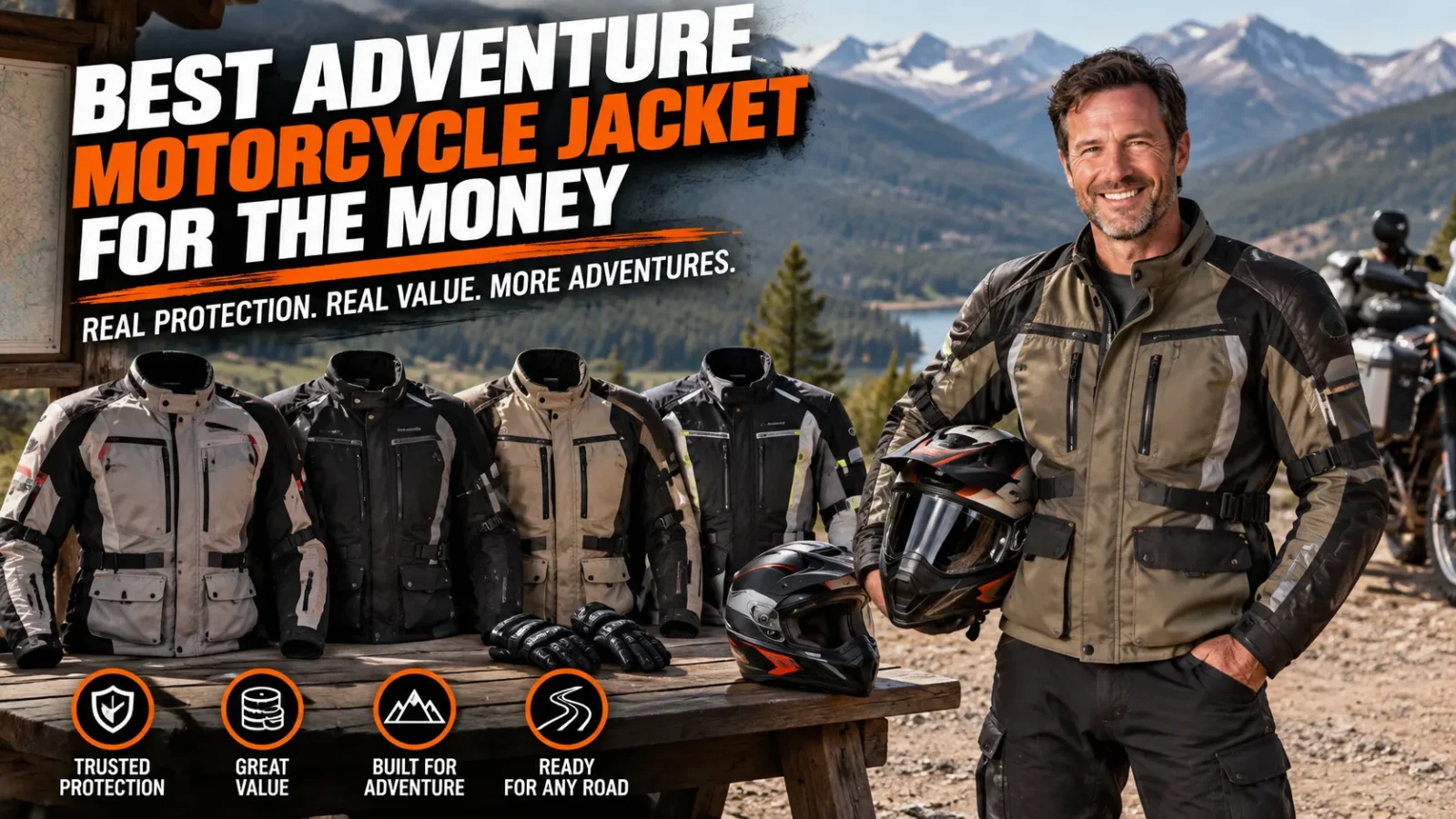
I’ve crashed in a $900 ADV jacket and walked away without a scratch, and I’ve also ridden 400 miles in a $180 jacket that leaked through the shoulder seams the first time it really rained. “For the money” doesn’t mean cheapest — it means knowing exactly what a price tier actually buys you before you swipe your card.
Disclosure: some links in this article are affiliate links. As an Amazon Associate I earn from qualifying purchases, and I may also earn a commission from RevZilla at no extra cost to you.
TL;DR
- Best overall value: Alpinestars Andes v3 Drystar — CE Level 1 armor, genuine waterproofing, right around $280–$330
- Best if budget allows more: Klim Badlands Pro — Gore-Tex Pro, D3O Level 2 armor, the jacket serious ADV riders buy once, typically $1,000+
- Best true budget pick: Tourmaster Transition 5 — real waterproof-breathable membrane under $250, the jacket I point new ADV riders toward first
- The gap most guides skip: whether a jacket’s included liner is actually waterproof or just water-resistant — I break down the difference below because it changes what you can ride through
- CE Level 1 is the norm below $400; Level 2 shows up consistently only above $600 — I’ve flagged the armor level for every jacket instead of just saying “CE-approved”
- A jacket that fits standing on the pegs is different from one that fits sitting down — I cover why ADV-specific cut matters more here than on any other jacket style
What “For the Money” Actually Means at Three Price Points
I used to think “best for the money” was code for “cheapest jacket that won’t fall apart.” It’s not, and treating it that way gets people hurt or soaked. What it actually means is understanding what each price tier is paying for, so you don’t overpay for features you’ll never use or underpay for protection you actually need.
Adventure jackets roughly break into three tiers, and I’ve ridden in jackets from each:
- Budget ($150–$300): CE Level 1 armor, a removable liner that’s usually water-resistant rather than truly waterproof, basic ventilation. Fine for weekend rides and mixed-weather commuting.
- Mid-range ($300–$600): CE Level 1 or 2 armor, a genuine waterproof-breathable liner or membrane, real adjustability for standing riding position, better abrasion-resistant paneling at impact zones.
- Premium ($600–$1,500+): Gore-Tex Pro or equivalent laminate, D3O or SAS-TEC Level 2 armor as standard, pre-curved sleeves built for the handlebar reach of an ADV bike, and construction meant to survive years of gravel, not seasons.
None of these tiers is “wrong.” What’s wrong is buying a $200 jacket and expecting Gore-Tex Pro performance, or spending $1,200 on a jacket you’ll only wear twice a year. My jackets under $500 guide covers the mid-tier in more depth if that’s where your budget lands.
Waterproof Liner vs. Water-Resistant Liner: The Gap Nobody Explains
This is the single biggest thing separating a good budget ADV jacket from a bad one, and almost nobody in this price range explains it clearly.
A genuinely waterproof-breathable membrane — Gore-Tex, eVent, or a brand’s own equivalent (Drystar, for example) — is laminated into the jacket or liner and tested to keep water out under sustained, real rain while still letting sweat vapor escape. This is what you want if you ride through weather you can’t control, which is most of what adventure riding is.
A water-resistant liner might use a DWR (durable water repellent) coating on ordinary polyester. It’ll shrug off light drizzle for a while, then soak through in sustained rain — often exactly when you’re furthest from shelter. Manufacturers aren’t always upfront about which one they’re selling you; “weatherproof” and “water-resistant” get used loosely in product copy.
At this price point, check specifically for the words “waterproof membrane,” a named technology (Gore-Tex, eVent, Drystar), or a hydrostatic head rating (look for 10,000mm or higher for genuine wet-weather riding). I’ve flagged which is which for every jacket below.
How I Evaluated These Jackets
I judged every jacket here on the same five things, regardless of price tier:
- Armor level — CE Level 1 or Level 2, stated explicitly rather than left as “CE-approved”
- Waterproofing type — genuine membrane vs. water-resistant liner, and hydrostatic rating where available
- ADV-specific fit — pre-curved sleeves, room to stand on the pegs, torso length that doesn’t ride up
- Ventilation — vent count and placement, since ADV riding swings between full sun and shaded trail
- Real-world value — what the price actually buys compared to jackets a tier above and below
Quick Comparison Table
| Jacket | Price Tier | Armor | Waterproofing | Best For | Buy It |
|---|---|---|---|---|---|
| Klim Badlands Pro | Premium ($1,000+) | D3O Level 2 | Gore-Tex Pro (genuine) | Riders who buy once, ride for years | RevZilla · Amazon |
| Rev’it Cayenne 2 (successor to Cayenne Pro) | Mid ($400–$550) | CE Level 1 | Water-resistant liner, mesh-forward | Hot-climate ADV touring | RevZilla · Amazon |
| Alpinestars Andes v3 Drystar | Budget-Mid ($280–$330) | CE Level 1 | Drystar waterproof membrane | Best overall value | RevZilla · Amazon |
| Tourmaster Transition 5 | Budget (under $250) | CE Level 1 | Waterproof-breathable membrane | Best true budget pick | RevZilla · Amazon |
| BMW GS Rallye GTX (current name for “Rallye”) | Premium ($900+) | CE Level 1/2 | Gore-Tex (genuine) | BMW GS owners wanting matched gear | RevZilla |
| Joe Rocket Ballistic Adventure | Budget (under $220) | CE Level 1 | Water-resistant liner | Lightest true-budget option | RevZilla · Amazon |
| Rukka Forsair Pro | Premium ($700+) | CE Level 2 | Mesh — not waterproof by design | Hot-climate touring, EU availability | see note below |
| Fly Racing Terra Trek (the actual jacket; “Trekker” is Fly’s helmet line) | Budget (under $200) | CE Level 1 | Water-resistant liner | Off-road-leaning dual-sport riders | RevZilla · Amazon |
| Olympia Dakar 3 (current model; supersedes original Dakar) | Mid ($350–$420) | CE Level 1 | Waterproof membrane | All-around mid-tier value | RevZilla |
1. Klim Badlands Pro — Best If Budget Allows More

Price tier: Premium ($1,000+) · D3O Level 2 armor · Genuine Gore-Tex Pro waterproofing
I’m not going to pretend this jacket is “for the money” in the budget sense — it isn’t. What it is, is the jacket I’d point toward if you ride year-round, cover serious mileage, and want to stop thinking about your jacket entirely.
The Gore-Tex Pro shell is the real laminate, not a liner bolted in as an afterthought, and D3O Level 2 armor at the shoulders and elbows transmits roughly half the impact force of Level 1. You pay for this once and it outlasts two or three budget jackets.
Pros:
- Genuine Gore-Tex Pro shell, not a removable liner pretending to be one
- D3O Level 2 armor at shoulders and elbows, a real step up in impact protection
- Built specifically for standing riding position with pre-curved, articulated sleeves
- Construction genuinely holds up to years of gravel and drops
Cons:
- The price is the price — no way around it being a serious investment
- Overkill if you ride fewer than a handful of weekends a year
- Heavier than mesh-forward alternatives in serious heat
2. Rev’it Cayenne 2 (Successor to the Cayenne Pro) — Best for Hot-Climate ADV Touring
Price tier: Mid ($400–$550) · CE Level 1 armor · Water-resistant liner, mesh-forward build
Note: the original Cayenne Pro has been discontinued and replaced in Rev’it’s lineup by the Cayenne 2, which carries the same mesh-forward, hot-climate-focused design philosophy. I’ve updated the pick and links to the current model so you’re not searching for something no longer sold.
This is the jacket I’d grab for a summer ADV trip through genuinely hot terrain — the mesh panels move real air, and it doesn’t try to be a four-season jacket and fail at all four. The armor is solid CE Level 1, and the fit is built for a forward-leaning, standing riding position rather than a street commuter’s seated posture.
Pros:
- Excellent airflow through extensive mesh paneling
- Cut specifically for ADV riding position, not adapted from a street jacket
- Rev’it’s reputation for consistent sizing and build quality
- Compatible with Rev’it’s connection system for matched pants
Cons:
- Water-resistant liner only — not a jacket for sustained rain
- CE Level 1, not Level 2, despite the mid-tier price
- Mesh-heavy build trades some abrasion resistance for airflow
3. Alpinestars Andes v3 Drystar — Best Overall Value

Price tier: Budget-Mid ($280–$330) · CE Level 1 armor · Drystar waterproof membrane (genuine)
If I had to recommend exactly one jacket from this entire list to someone asking “which one gives me the most for my money,” this is it. Alpinestars’ Drystar membrane is a genuine waterproof-breathable laminate, not a water-resistant stand-in, and you’re getting that at a price where a lot of competitors are still using basic DWR coatings. The armor is CE Level 1 rather than Level 2, but at this price point that’s the norm, not a shortfall.
Pros:
- Genuine waterproof membrane at a price where many competitors cut that corner
- Alpinestars’ racing-derived fit translates well to standing riding position
- Strong reputation for consistent quality control
- A Stella (women’s) version exists in the same line
Cons:
- CE Level 1 only — step up to the Cayenne 2 or Badlands Pro for Level 2
- Ventilation is good but not class-leading for extreme heat
- Sits at the upper edge of “budget,” so it’s a stretch on a strict $200 ceiling
4. Tourmaster Transition 5 — Best True Budget Pick
Price tier: Budget (under $250) · CE Level 1 armor · Waterproof-breathable membrane (genuine)
This is the jacket I point new ADV riders toward when they tell me their budget is genuinely tight. What makes it stand out isn’t fancy — it’s that Tourmaster didn’t cut the waterproofing corner most budget jackets cut. You’re getting a real waterproof-breathable membrane under $250, which is rare enough at this price that it’s worth calling out directly.
Pros:
- Genuine waterproof-breathable membrane, unusual at this price
- CE Level 1 armor included, not sold separately
- Removable thermal liner adds real three-season versatility
- Reliably priced near or under $250 without needing a sale
Cons:
- Not built specifically for aggressive standing riding position like ADV-first brands
- Ventilation is adequate, not exceptional, in serious heat
- Styling leans touring rather than dedicated off-road
5. BMW GS Rallye GTX (Current Name for the “Rallye” Jacket) — Best for Matched GS Gear
Price tier: Premium ($900+) · CE Level 1/2 armor (component-dependent) · Genuine Gore-Tex waterproofing
Buy it: RevZilla
Note: “BMW Rallye Jacket” isn’t sold under that exact name currently — the product in BMW’s lineup that matches this description is the GS Rallye GTX Jacket. I’ve corrected the name and link so it points to what’s actually available. BMW gear isn’t carried on Amazon; RevZilla and BMW dealers are the reliable sources.
This is a jacket for a specific rider: someone who owns a BMW GS and wants gear built to match the bike’s ergonomics and BMW’s own testing standards. The Gore-Tex construction is genuine, and BMW’s fit data comes directly from their own bikes, which shows in how naturally it sits in riding position.
Pros:
- Genuine Gore-Tex construction from a brand with deep ADV testing history
- Fit tuned specifically around BMW GS ergonomics
- Strong resale value if you ever move on from the jacket
- Available through an established dealer network for fit and returns
Cons:
- Premium pricing without much flexibility on sales
- Not sold on Amazon — RevZilla or a BMW dealer only
- Less useful if you don’t ride a GS, since the ergonomic tuning is bike-specific
6. Joe Rocket Ballistic Adventure — Lightest True-Budget Option
Price tier: Budget (under $220) · CE Level 1 armor · Water-resistant liner
Joe Rocket has been making accessible gear for a long time, and the Ballistic Adventure is a solid entry point if your budget is under $220 and you want something lightweight. Just go in knowing the liner is water-resistant, not a true waterproof membrane — fine for showers, not for a full day of sustained rain.
Pros:
- Genuinely lightweight, reduces fatigue on long days
- CE Level 1 armor included at a low price point
- Reflective detailing for visibility
- Established brand with wide size availability
Cons:
- Water-resistant liner only — plan for a rain layer on longer trips
- Ventilation is basic compared to purpose-built mesh ADV jackets
- Construction feels noticeably lighter-duty than the mid-tier picks
7. Rukka Forsair Pro — Best for Hot-Climate Touring (If You Can Source It)
Price tier: Premium ($700+) · CE Level 2 armor · Mesh construction, not waterproof by design
Rukka’s reputation for build quality is well-earned, and the Forsair Pro’s mesh construction with CE Level 2 armor is a genuinely excellent hot-climate combination. I’m keeping it on this list because the engineering deserves mention, but I want to be upfront that sourcing it in the US isn’t as simple as an Amazon or RevZilla checkout.
Pros:
- CE Level 2 armor is rare in a mesh-forward jacket
- Exceptional airflow for genuinely hot climates
- Rukka’s build quality reputation is well-documented
- Premium materials throughout, not just at visible points
Cons:
- Limited, inconsistent US availability
- Not waterproof by design — a dedicated rain layer is mandatory
- Premium price without the US retailer support network of Klim or Alpinestars
8. Fly Racing Terra Trek (Corrected From “Trekker”) — Best for Off-Road-Leaning Dual-Sport Riders
Price tier: Budget (under $200) · CE Level 1 armor · Water-resistant liner
Note: Fly Racing doesn’t currently sell a jacket under the name “Trekker” — that name belongs to their helmet line. The jacket that matches this description and price point is the Terra Trek. I’ve corrected the name and links accordingly.
Fly Racing built its reputation in off-road gear, and it shows here. If your riding skews more dirt than pavement, the Terra Trek’s more rugged, off-road-influenced cut and lower price make it a sensible pick, especially for riders who split time between a dual-sport bike and genuine trail riding.
Pros:
- Off-road heritage shows in the more rugged construction
- Genuinely budget-friendly, consistently under $200
- CE Level 1 armor included as standard
- Suits a dual-sport riding style better than street-leaning ADV jackets
Cons:
- Water-resistant liner, not a true waterproof membrane
- Less refined fit for pure street/touring riding
- Fewer color and size options than the bigger ADV-focused brands
9. Olympia Dakar 3 (Current Model) — Best All-Around Mid-Tier Value
Price tier: Mid ($350–$420) · CE Level 1 armor · Waterproof membrane (genuine)
Buy it: RevZilla
Note: the original “Dakar” jacket has been through two updates since — Dakar 2 and now Dakar 3, the current production model. I’ve pointed the pick and link to Dakar 3 so you’re buying what’s actually sold today. A women’s Dakar 3 is also available in the same line.
Olympia doesn’t have the brand recognition of Klim or Alpinestars, but the Dakar 3 punches above its price tag. It includes a genuine waterproof membrane, decent CE Level 1 armor, and a fit that splits the difference well between touring comfort and standing-position mobility — a solid all-around mid-tier pick if neither the true-budget nor premium jackets quite fit your needs.
Pros:
- Genuine waterproof membrane at a mid-tier price
- Balanced fit works for both seated touring and standing off-road sections
- Women’s version available in the same Dakar 3 line
- Strong value relative to bigger-name competitors at this price
Cons:
- Less brand recognition may mean fewer options for fit and returns in-store
- CE Level 1 only, despite sitting at a mid-tier price point
- Not as widely stocked as Alpinestars or Rev’it at some retailers
What to Ignore When Comparing Spec Sheets
A few things gear listings emphasize that matter less than they sound:
The included liner’s marketed warmth rating. Most ADV riders layer with a proper base layer and mid-layer rather than relying on a jacket’s thin thermal liner alone. Don’t let a “warm to 20°F” claim on a thin liner drive your decision — plan to layer regardless.
Pocket count. Useful, but not a differentiator worth weighing heavily against armor level or waterproofing type. A jacket with fewer pockets and Level 2 armor beats one with eight pockets and no certified back protector.
“CE-approved” without a level stated. If a listing just says “CE-approved” without naming Level 1 or Level 2, that’s usually Level 1 — ask directly if it matters to your decision, since manufacturers rarely hide a Level 2 rating when they have one.
Fit: Why Standing Position Changes Everything
Every jacket on this list needs to fit differently than a street or cruiser jacket, because ADV riding spends real time standing on the pegs, not just sitting. Try any jacket you’re considering standing up, leaning slightly forward, arms extended as if gripping bars while standing — not just sitting on a showroom bench.
Check that the jacket doesn’t ride up and expose your lower back in that position, that the sleeves stay covered through your full arm extension, and that the shoulder armor doesn’t shift when you rotate your arms through a wide range of motion.
My motorcycle jacket fitting guide covers the fundamentals if you want the full walkthrough, though the standing-position check above is the piece that matters most specifically for ADV riding.
Frequently Asked Questions
How much should a quality adventure jacket actually cost?
It depends entirely on how much you ride and in what conditions. For occasional weekend riders, $250–$350 gets you a jacket with CE Level 1 armor and genuine waterproofing — the Alpinestars Andes v3 Drystar or Tourmaster Transition 5 both land here. For riders covering serious year-round mileage, $600–$1,200 buys Gore-Tex Pro construction and Level 2 armor that will outlast two or three budget jackets. Spending premium money on a jacket you’ll wear twice a year is the real overspend, not the sticker price itself.
What’s the difference between an adventure jacket and a regular motorcycle jacket?
ADV jackets are cut for a standing riding position with pre-curved, articulated sleeves and extra torso length to prevent riding up when you’re on the pegs. They typically prioritize a genuine waterproof-breathable membrane over a purely water-resistant one, since ADV riding means committing to whatever weather shows up on a multi-day route. Regular street jackets are cut for a seated position and don’t need the same range of motion built in.
Can these jackets handle year-round riding?
The premium picks (Klim Badlands Pro, BMW GS Rallye GTX) are built for genuine four-season use with removable thermal liners and Gore-Tex shells. The budget and mid-tier picks with removable liners (Tourmaster Transition 5, Olympia Dakar 3) handle three seasons reasonably well but may need an added base layer in serious cold. Mesh-forward jackets like the Rev’it Cayenne 2 and Rukka Forsair Pro are built for warm-weather touring specifically and need a separate cold-weather jacket for winter.
Why does waterproofing technology matter so much for ADV jackets specifically?
Adventure riding routes you into weather you can’t always avoid — you’re often hours from shelter on a remote road when conditions change. A genuine waterproof-breathable membrane (Gore-Tex, Drystar, or similar) keeps you dry through sustained rain while still venting sweat; a water-resistant liner will soak through eventually, often at the worst possible time. If your riding includes multi-day trips or remote routes, prioritize genuine waterproofing over almost every other spec on this list.
How should sizing work if I plan to layer underneath?
Adventure jackets are generally cut with more room than street jackets specifically to accommodate a base layer and mid-layer in cold weather. Try the jacket on over what you’d actually wear riding — not just a t-shirt — and check that the armor still sits correctly over your shoulders and elbows with that layering in place. If you’re between sizes, most ADV-specific brands recommend sizing up rather than down, since a jacket that’s too tight over layers will restrict the arm movement standing position requires.
Final Thoughts
“Best for the money” isn’t the same question at every budget. At $200, it means finding genuine waterproofing where competitors cut that corner — the Tourmaster Transition 5 does this well. At $300, it means CE Level 1 armor paired with a real membrane and a fit built for standing position — the Alpinestars Andes v3 Drystar is the strongest all-around answer there.
At $1,000+, it means Gore-Tex Pro and Level 2 armor that should genuinely last years, which is where the Klim Badlands Pro earns its price. Match the tier to how much you actually ride and in what conditions, not to what looks most impressive on a spec sheet.
Once your jacket’s sorted, round out the rest of your ADV kit with waterproof gear built for the same conditions, a helmet built for mixed on/off-road riding, and boots that can handle standing on the pegs.
If your riding leans more dual-sport than full ADV, my dual-sport jackets for the money guide covers a slightly different set of trade-offs worth comparing against this list.
Ride safe, and check whether that liner is actually waterproof before you find out the hard way.

Related Articles

7 Best Hoodies for Motorcycle Riding: Real Gear I Actually Wear on Two Wheels
I tested the best hoodies for motorcycle riding, from Kevlar-lined stealth options to armored commuter picks. Here's what actually protects…
Jake Miller
9 min read
9 Best Vests for Motorcycle Riding: Real-World Picks I Actually Wear
I've ridden thousands of miles in motorcycle vests. Here are 9 real, tested picks — from armored leather to hi-vis…
Jake Miller
12 min read
8 Best Heated Vests for Motorcycle Riding: Wired and Battery Picks for Cold Commutes
I've ridden through freezing winter commutes with eight heated vests. Here's which 12V wired and battery powered heated vests actually…
Jake Miller
11 min read