
8 Best Motorcycle Spray Cleaners for a Cleaner, Better-Cared-For Bike
 Jake Miller
12 min read
I reach for a spray cleaner when road film, bugs, or dust start hiding the details I like about my motorcycle. The right formula can make washing simpler, but the wrong one can leave residue or be unsuitable for a surface, so I match the product to the job and check its label before spraying.
Disclosure: some links in this article are affiliate links. As an Amazon Associate I earn from qualifying purchases, and I may also earn a commission from RevZilla at no extra cost to you.
I’m focusing here on cleaners and cleaner-polishes, not paint products. If I’m planning a color change or a repair instead of a wash, I’d look at my guide to best spray paint for motorcycle for a different kind of project.
- I’d choose S100 or Muc-Off for a general rinse-off motorcycle wash.
- I use Honda or Bike Spirits cleaner-polish for quick touch-ups, not heavy mud.
- I keep dedicated plastic cleaner, such as Plexus, for suitable plastic surfaces.
- I avoid hot parts, brake surfaces, and letting cleaner dry on the bike.
How I Choose a Spray Cleaner for My Motorcycle
First, I decide whether I need a real wash or a quick detail. Rinse-off cleaners are my choice for road grime and bugs, while cleaner-polishes are more convenient for light dust and fingerprints on surfaces their labels approve.
I also think about the finish. A gloss-painted tank, matte fairing, clear windscreen, rubber component, and bare metal part may not all react the same way to one product. If I’m unsure, I read the label, check the owner’s manual, and test a small hidden spot.
My prices below are approximate U.S. retail ranges and can change with bottle size and retailer. I treat each product’s directions as the final word, especially for dwell time, dilution, rinsing, and surface compatibility.
1. S100 Total Cycle Cleaner — My Pick for a Thorough Wash
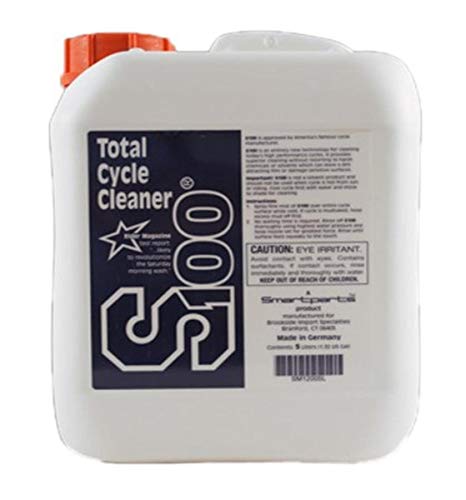
When my bike needs more than a quick wipe, I’d reach for S100 Total Cycle Cleaner. It’s a spray-on, rinse-off cleaner made for motorcycle cleaning, and it’s known for helping lift road dirt and grime without requiring me to scrub every panel aggressively.
I like that S100 Total Cycle Cleaner is sold in ready-to-use bottles, including larger refill-style sizes depending on the retailer. A typical bottle often lands around $15 to $25, with the exact price varying by size and seller.
Where I find it most useful
I’d use S100 Total Cycle Cleaner after a dusty ride or when bugs and road film have built up around the front end. I follow the label’s application and rinse instructions, and I don’t let the product dry on the bike in direct sun.
I still use care around sensitive finishes and components. I keep any general wash product away from brake discs and pads, and I avoid spraying a hot engine or exhaust. If grime is stubborn, I’d rather repeat a careful wash than attack the surface with a harsh brush.
2. Muc-Off Nano Tech Motorcycle Cleaner — My Everyday Wash Choice

Muc-Off Nano Tech Motorcycle Cleaner is a familiar choice for a reason: it’s a dedicated motorcycle wash supplied in a spray bottle, and its manufacturer promotes it as a biodegradable, non-acidic cleaner. I like that it’s intended for a broad range of motorcycle surfaces, though I still check the current label for any material-specific warnings.
The cleaner is typically available in a 1-liter bottle, with pricing commonly around $15 to $25. I find the trigger bottle convenient for applying the product to panels and hard-to-reach areas before rinsing.
Why I’d keep it on the wash shelf
I’d choose Muc-Off Nano Tech Motorcycle Cleaner for regular cleaning when my bike has ordinary road dirt rather than a thick coating of grease. I use it as directed, give it only the recommended time to work, and rinse thoroughly instead of assuming “safe for many surfaces” means safe to leave on indefinitely.
For matte finishes, I’m especially cautious about using any cleaner-polish or wax afterward. I use a product made specifically for that finish, such as the options I discuss in my guide to best motorcycle cleaner for matte paint.
3. Motul MC Care E2 Moto Wash — My Choice for Road Film

Motul MC Care E2 Moto Wash is a ready-to-use motorcycle cleaner that comes in a spray bottle. I consider it when I want a dedicated wash product from a brand that also makes motorcycle lubricants and maintenance supplies.
Depending on the bottle size and seller, I commonly see Motul MC Care E2 Moto Wash priced in the approximate $15 to $25 range. I like the straightforward spray-and-rinse format for routine cleaning, but I still follow the directions rather than guessing how long it should sit.
How I’d use it
I’d spray Motul MC Care E2 Moto Wash onto a cool bike, allow the stated working time, and rinse it off completely. I use a soft wash mitt or detailing brush only where needed, because rubbing grit across paint is an easy way to create fine scratches.
After washing, I dry the bike with a clean microfiber towel and inspect spots where water collects. If I’ve washed around the chain, I check its condition and relubricate it when needed, following the motorcycle and chain-lube manufacturers’ guidance.
4. WD-40 Specialist Motorcycle Cleaner — My Practical All-Around Option

WD-40 Specialist Motorcycle Cleaner is a product I’d consider when I want a motorcycle-specific wash from a widely available brand. It is sold as a spray cleaner for motorcycle surfaces, and its ready-to-use format makes it simple to apply without mixing a concentrate.
Pricing often falls around $10 to $18, depending on bottle size and retailer. I see its broad availability as a useful advantage: it can be easier to find locally than some specialist detailing products.
What I keep in mind
I use WD-40 Specialist Motorcycle Cleaner according to its current label, because formulations and instructions can vary by market. I don’t treat it as a chain degreaser, brake cleaner, or substitute for a product designed for a specific maintenance task.
For me, this is a sensible choice for regular exterior cleaning when I want a motorcycle-labeled product and a convenient spray bottle. I’d still test an inconspicuous area first if I were unsure about a particular coating or aftermarket component.
5. Pro Honda Spray Cleaner & Polish — My Quick-Touch-Up Pick

Pro Honda Spray Cleaner & Polish is a different kind of product from the rinse-off washes above. I think of it as a cleaner-polish for lighter cleaning and finishing, not my first choice for a bike covered in mud or gritty road debris.
It’s commonly sold in an aerosol can, often around 12 ounces, and typically costs about $10 to $18. I like the convenience of a spray-and-wipe product when I want to tidy suitable surfaces without setting up a full wash.
When I reach for it
I’d use Pro Honda Spray Cleaner & Polish for light dust, fingerprints, or a quick finish on surfaces its label approves. Before wiping, I remove loose grit so I don’t drag it over the paint, and I use a clean microfiber cloth rather than an old shop rag.
Because this product is a polish as well as a cleaner, I wouldn’t automatically use it on a matte finish. I also keep it away from tires, grips, seat contact areas, brake components, and any surface where added slickness or residue could be a safety concern.
6. Bike Spirits Spray Cleaner & Polish — My Fast Detailer

Bike Spirits Spray Cleaner & Polish is another aerosol cleaner-polish aimed at motorcycle care. I’d pick it for light detailing and a quick wipe-down, rather than for rinsing away heavy grime from a long ride.
It’s generally sold in an aerosol can and often costs about $8 to $15, depending on the retailer. Its appeal to me is convenience: I can keep a can with my detailing supplies and use it for small touch-ups when the bike is already reasonably clean.
My surface and safety checks
I always read the can before using Bike Spirits Spray Cleaner & Polish, particularly if I’m working around a windscreen, matte paint, or an aftermarket coating. I apply it to a cloth when I want more control, rather than spraying near components I need to keep clean and dry.
I don’t use a cleaner-polish to remove embedded grit. If the panel feels gritty, I wash and rinse it first; that simple step reduces the chance of scratching paint while I wipe.
7. Plexus Plastic Cleaner — My Pick for Suitable Plastic Parts
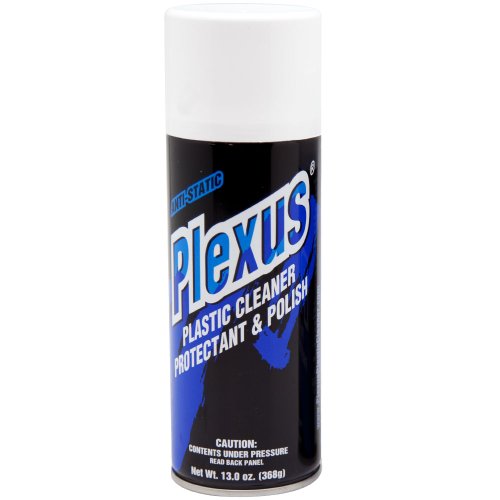
Plexus Plastic Cleaner is a plastic-focused spray cleaner that I’d keep for the parts it is designed to treat, such as suitable plastic panels and clear plastic surfaces. It is not my all-over-bike wash, but a specialized product can be handy when I want to care for a particular material.
Plexus is commonly sold as an aerosol, often in a 13-ounce can, with prices that can range roughly from $15 to $25. I check the product label and the part maker’s instructions before using it on a motorcycle windscreen, instrument lens, or coated plastic.
Why I don’t use it everywhere
I use Plexus Plastic Cleaner only where it’s appropriate, and I apply it with a clean, soft cloth. I avoid assuming that every clear panel is identical; some windscreens and screens have coatings or manufacturer-specific care instructions.
If I’m repairing or refinishing plastic bodywork rather than cleaning it, I switch to a product intended for that job. I’ve gathered options in my guide to best spray paint for motorcycle plastics.
8. MOTOREX Moto Clean 900 — My Dedicated Bike-Wash Alternative

MOTOREX Moto Clean 900 is a motorcycle wash cleaner sold in a spray-ready format. I’d consider it as another dedicated option for lifting everyday dirt from motorcycle surfaces, especially if I already buy MOTOREX maintenance products.
Its price varies by bottle size and shop, but I commonly expect a specialist wash cleaner in this category to cost around $15 to $25. I check the packaging for the exact application and rinsing directions because product details can differ between markets.
How I fit it into my routine
I’d use MOTOREX Moto Clean 900 for a normal exterior wash, applying it to a cool motorcycle and rinsing it off as directed. I keep a separate, suitable cleaner for chain maintenance and never assume a general wash product will safely remove chain lubricant.
When I’m cleaning around painted components, I work patiently and rinse thoroughly. For repainting a tank or engine part, I’d use a dedicated coating product instead of a wash formula; my related guides cover the best spray paint for motorcycle tank and the best spray paint for motorcycle engine.
How I Use Spray Cleaner Without Damaging the Bike
I start with a cool, shaded motorcycle
I avoid applying cleaner to hot engine parts or paint warmed by direct sun. Heat can make liquid evaporate quickly, which may leave marks or make the product harder to rinse away.
I park on a stable surface and give the motorcycle time to cool. If the cleaner’s directions call for a dry or wet surface, I follow that specific instruction instead of assuming every formula works the same way.
I keep cleaner away from critical surfaces
I’m careful around brake discs and pads, tires, grips, and seat contact areas. If I’m using a polish or protectant, I apply it to a cloth when possible and keep it away from surfaces where slick residue could affect control or braking.
I also avoid spraying electrical connectors or openings directly. I use a gentle rinse rather than a high-pressure jet close to bearings, seals, or electrical components.
I rinse, dry, and inspect
After a rinse-off cleaner, I rinse thoroughly and dry the bike with clean microfiber towels. I check seams and crevices for trapped water, then inspect the chain and other parts I may have disturbed during washing.
If my goal is a repair or a fresh finish rather than cleaning, I use the appropriate product for that material. For example, I’d research paint intended for fairings in my guide to the best spray paint for motorcycle fairings, rather than expecting a cleaner to restore damaged paint.
My Final Picks
For a full wash, I’d start with S100 Total Cycle Cleaner or Muc-Off Nano Tech Motorcycle Cleaner. Both are recognizable motorcycle-specific rinse-off choices, and I can use either as part of a careful wash routine when I follow the product label.
For light touch-ups, I’d consider Pro Honda Spray Cleaner & Polish or Bike Spirits Spray Cleaner & Polish, while keeping in mind that cleaner-polishes aren’t substitutes for washing away grit. For plastic parts, Plexus Plastic Cleaner gives me a more focused option, provided the surface maker approves it.
My best spray cleaner for motorcycle care is ultimately the one that fits the surface and the mess I’m dealing with. I read directions, test cautiously, and keep cleaners off safety-critical parts; that approach matters just as much as the name on the bottle.
Frequently Asked Questions
Which spray cleaner is best for a full motorcycle wash?
I’d start with S100 Total Cycle Cleaner or Muc-Off Nano Tech Motorcycle Cleaner for a broad, rinse-off wash, following the label and your motorcycle manual.
Can I use spray cleaner on motorcycle brakes?
I keep general-purpose cleaners off brake discs and pads. If overspray reaches them, I follow the brake manufacturer’s cleaning guidance before riding.
What should I use to clean a matte motorcycle finish?
I choose a product explicitly approved for matte finishes and test it on a hidden area first. I avoid polish and wax products that can add unwanted gloss.
How often should I clean my motorcycle?
I clean it when dirt, salt, or road grime builds up, rather than on a rigid schedule. After a wet or salty ride, I rinse and dry it promptly.

Related Articles

6 Best Motorcycle Fork Paints for a Durable, Clean Finish
I compare six paints for motorcycle fork lowers, with practical notes on durability, finish, prep, cost, and the fork surfaces…
Jake Miller
12 min read

Remove Motorcycle Tank Badges Safely: A Rider’s Paint-Protecting Guide
Learn how I safely remove motorcycle tank emblems, loosen stubborn adhesive, protect paint, clean residue, and spot when pins or…
Jake Miller
11 min read

How I Remove Motorcycle Tank Stickers Without Damaging the Paint
Learn how I safely remove decals and sticky residue from a motorcycle tank without damaging paint, with tools, step-by-step tips,…
Jake Miller
11 min read