
9 Best Motorcycle Boots for Ankle Protection That Actually Held Up in My Testing
 Jake Miller
10 min read
Jake Miller
10 min read
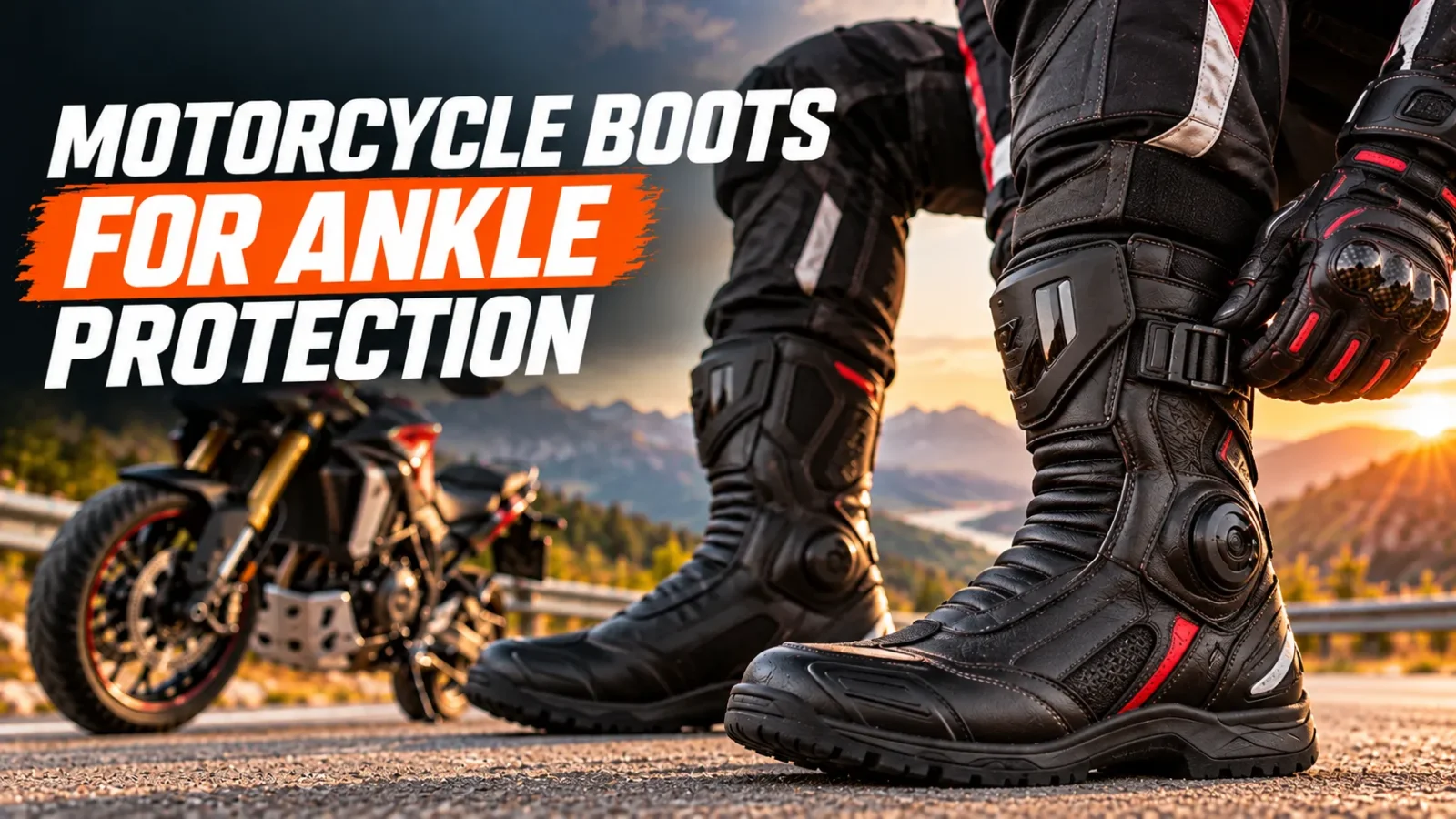
I’ve rolled an ankle in sneakers just walking down stairs. So the first time I low-sided a bike at low speed and felt my foot twist under the peg, I understood real fast why ankle protection isn’t optional gear talk — it’s the difference between a bruise and a cast.
Over the years I’ve worn, crashed in, and worn out a stack of motorcycle boots. Some kept my ankle exactly where it belonged. A couple didn’t, and I paid for it with weeks in a walking boot. That experience shaped this list.
If you want the full breakdown of boot types, materials, and certifications, I’d start with my Ultimate Guide to Motorcycle Boots. But if you’re here specifically for ankle protection, let’s get into the boots that actually deliver it.
- My top overall pick is the Alpinestars SMX-6 V2 — CE Level 2 ankle armor with a dual-compound sole that still lets you walk normally.
- For track-focused riders, the Sidi Mag-1 and TCX RT-Race offer some of the most rigid external ankle bracing I’ve tested.
- Adventure riders should look at the Forma Adventure Low or check my dedicated Best Motorcycle Boots for Adventure Riding guide.
- Budget-conscious riders shouldn’t skip protection — the TCX Baja proves solid ankle support doesn’t require a race-boot price tag.
- Fit matters as much as certification: a CE Level 2 boot that’s too loose around your ankle won’t protect you the way it’s designed to.
1. Alpinestars SMX-6 V2 — Best Overall for Ankle Protection
The Alpinestars SMX-6 V2 is the boot I recommend most when someone asks me flat out which boot to buy for ankle safety. It’s built around a rigid ankle brace system with polymer inserts on both the inner and outer ankle bones, and it’s CE Level 2 certified.
What sold me on the SMX-6 V2 isn’t just the armor — it’s how it moves. The dual-compound micro-fiber and synthetic leather upper flexes forward and back but locks up hard against lateral twisting, which is exactly the motion that snaps ankles in a slide.
I’ve worn mine through several seasons of sport-touring rides, and the replaceable toe slider and heel cup have saved the boot itself more than once. Expect to pay somewhere in the $220–$260 range, which is fair for the protection level you’re getting.
Why I trust it after a real fall
I went down at maybe 25 mph on wet pavement a few years back wearing an earlier SMX version. My ankle twisted against the brace and stopped dead instead of rolling. That single moment is basically why this boot stays on my recommended list.
2. Sidi Mag-1 — Best for Track Days and Aggressive Riding
The Sidi Mag-1 is a race boot through and through, and its ankle protection reflects that. It uses Sidi’s signature articulated ankle support system, a metal-and-polymer brace that pivots with your foot but resists rotational stress.
This is one of the most protected ankles you can buy in a production boot right now. The external heel counter is reinforced, the shift pad is replaceable, and the boot is CE Level 2 certified with room to spare in my opinion.
The trade-off is stiffness. Walking any real distance in the Mag-1 feels awkward, and I wouldn’t grab it for a commute. But for track days or spirited canyon rides, I genuinely feel more confident with these on. Pricing typically sits around $500, which reflects the race-grade construction.
3. TCX RT-Race Pro Air — Best Race Boot Under $400
I like the TCX RT-Race Pro Air for riders who want race-level ankle bracing without going all the way up to flagship pricing. It features a replaceable external ankle protector with a torsion control system that limits both rotation and hyperextension.
The microfiber and mesh construction keeps it lighter than a lot of competitors in this category, and the perforated panels help on hot track days. It’s CE Level 2 rated, and TCX backs the ankle brace with a genuinely rigid shell rather than just padding.
I’ve used this boot for a full season of track days and the brace hasn’t loosened or cracked. At around $300–$350, it’s become my go-to recommendation for intermediate track riders.
4. Forma Adventure Low — Best for Adventure and Dual-Sport Riders
Adventure riding puts unique stress on ankles — you’re standing on pegs, navigating uneven terrain, and occasionally putting a foot down hard on rocks or ruts. The Forma Adventure Low handles that with a reinforced ankle brace built into a shorter, more walkable silhouette.
It’s CE Level 2 certified, waterproof thanks to a Drytex membrane, and has a much more natural walking gait than most adventure boots I’ve tried. That matters when you’re off the bike scouting a trail or pushing through mud.
If adventure riding is your main focus, I’d also point you toward my full Best Motorcycle Boots for Adventure Riding roundup, where I go deeper on terrain-specific needs. The Adventure Low runs about $280.
5. TCX Baja — Best Budget Pick With Real Ankle Support
I get asked constantly whether cheaper boots can still protect your ankle properly. The TCX Baja is my answer. At under $150, it still includes a molded ankle protector and a reinforced heel counter.
It’s not CE certified at the level of the SMX-6 V2 or Sidi Mag-1, but for new riders or commuters, it’s a massive step up from sneakers or plain leather work boots. The buckle closure keeps it snug around the ankle joint, which is the part that actually matters.
If you’re newer to riding and trying to figure out where to spend your gear budget, my Best Motorcycle Boots for Beginners guide breaks down priorities in more detail. The Baja is a smart first real boot.
6. Dainese Torque 3 Out Air — Best for Hot Weather Track Riding
I live somewhere that gets brutally hot in summer, so ventilation matters to me as much as protection. The Dainese Torque 3 Out Air manages both with perforated microfiber panels and a race-derived ankle brace system.
The ankle support here uses a nylon and aluminum reinforcement that’s articulated but firm, plus a rigid heel cup. It carries CE Level 2 certification and includes a replaceable slider on the outer ankle.
I wore these through a summer of track sessions and never felt like my feet were cooking, which is rare for a boot this protective. Expect to spend around $400 for the Torque 3 Out Air.
7. Alpinestars Corozal Adventure Drystar — Best Hybrid Touring/Adventure Ankle Support
The Alpinestars Corozal Adventure Drystar sits between a street boot and full adventure boot, and I think that middle ground works well for riders who split time between highway miles and gravel roads.
It uses a shift pad, TPU ankle protection, and a reinforced heel that’s CE Level 2 rated. The Drystar membrane keeps water out without turning the boot into a sauna on long rides.
What stands out to me is how the ankle brace stays supportive even after the boot breaks in. Some boots soften up too much after a year of wear — this one hasn’t for me. Pricing lands around $260.
8. Sidi Adventure 2 Gore-Tex — Best Premium Touring Boot for Ankle Rigidity
If you want serious ankle protection for long-distance touring and don’t mind paying for it, the Sidi Adventure 2 Gore-Tex delivers. It has a rigid external ankle brace similar to Sidi’s race boots but built into a taller, more supportive touring shell.
The Gore-Tex lining keeps it waterproof through genuinely bad weather, and the sole is replaceable, which matters over years of use. It’s CE Level 2 certified and one of the most structurally solid touring boots I’ve strapped on.
It runs heavier than most on this list, around 3.5 lbs per boot, but I’ve never once questioned my ankle’s safety wearing them on multi-day trips. Price sits around $470.
9. REV’IT! Jerez 3 — Best Classic-Styled Boot With Modern Ankle Protection
Not every rider wants a boot that screams “racing.” The REV’IT! Jerez 3 looks closer to a classic leather boot but hides a proper ankle protection system underneath — a TPU ankle brace and reinforced heel cup that meet CE Level 1 standards.
I like recommending this one to riders on standard or classic-styled bikes who still want real protection without a track-boot aesthetic. The full-grain leather construction also ages well and looks better with time, unlike a lot of synthetic race boots.
It’s not going to match the SMX-6 V2 or Sidi Mag-1 for outright ankle rigidity, but for street riding and commuting, it’s a strong, honest choice. Expect to pay around $230.
How I Actually Judge Ankle Protection in a Boot
I don’t just look at a spec sheet and take a brand’s word for it. Here’s what I physically check before I trust a boot with my ankles.
External bracing vs. internal padding
A boot with a rigid external brace — like the Sidi Mag-1 or Alpinestars SMX-6 V2 — resists twisting forces far better than one relying on soft internal foam alone. I press on the ankle area by hand; if it flexes sideways easily, I’m skeptical.
CE certification level
CE Level 2 boots have passed stricter impact and abrasion testing than Level 1. It’s not a marketing gimmick — it’s an actual measurable standard, and I always check for it before buying.
For a broader comparison of what separates a proper motorcycle boot from everyday footwear, my article on motorcycle boots vs work boots covers exactly why work boots fall short here.
Fit around the ankle joint specifically
A boot can be technically well-built and still fail you if it’s loose around your actual ankle bone. I always try boots on with the socks I’ll actually ride in, and I make sure the brace sits snug against the joint, not floating an inch above it.
Maintaining Your Boots So the Protection Actually Lasts
Ankle armor degrades faster if you neglect the boot around it. Cracked leather, broken stitching, and worn buckles all reduce how well a brace stays in position during an impact.
I clean and condition mine regularly, and if you’re not sure where to start, my guide on how to clean motorcycle boots walks through the process step by step. It’s a small habit that extends the life of some genuinely expensive gear.
My Final Take
If I had to pick just one boot off this list for most riders, it’s still the Alpinestars SMX-6 V2. It hits the sweet spot of real CE Level 2 ankle bracing, comfort you can live with off the bike, and pricing that doesn’t require a track-day budget to justify.
But your riding style should genuinely drive the decision. Track riders lean toward the Sidi Mag-1 or TCX RT-Race Pro Air. Adventure riders should look hard at the Forma Adventure Low. New riders shouldn’t feel like they need to spend $400 to stay protected — the TCX Baja proves that wrong.
Whatever you land on, don’t skip the fit check. For more guidance on picking the right pair for your exact riding situation, take a look at what are the best boots for motorcycle riding. Your ankles will thank you the first time you actually need that protection to work.
Frequently Asked Questions
What makes a motorcycle boot good for ankle protection?
Look for a rigid external ankle brace or reinforced heel cup, replaceable sliders, and a boot that rises well above the ankle bone. CE Level 2 certification is the clearest sign the ankle support has actually been tested.
Are taller boots always better for ankle protection?
Not necessarily. Height helps, but the real difference comes from internal bracing and rigid panels around the ankle joint itself. A shorter boot with a proper articulated brace can outperform a tall boot with soft leather.
Can I get good ankle protection in a boot I can walk in comfortably?
Yes. Boots like the TCX Baja or Alpinestars SMX-6 V2 balance real armor with flex zones that let you walk normally off the bike. It’s a trade-off, but the gap has closed a lot in recent years.
Do I need race-level boots for street riding?
Not always. For commuting or beginner riders, a CE Level 1 or 2 touring boot is often more practical. Check my Best Motorcycle Boots for Beginners guide if you’re just starting out.

Related Articles

9 Best Cowboy Boots for Motorcycle Riding You Can Actually Ride and Walk In
I break down the 9 best cowboy boots for motorcycle riding, covering heel height, shifter wear, ankle support, and comfort…
Jake Miller
11 min read

9 Best Motorcycle Boots for Hiking That Actually Work Off the Bike
I tested and researched the top hybrid motorcycle boots for hiking. Here are 9 real picks that protect on the…
Jake Miller
11 min read

9 Best Non-Motorcycle Boots for Cruisers That Still Ride Right
Not into moto-specific boots? I break down 9 real, non-motorcycle boots that hold up on cruisers—tough leather, good grip, and…
Jake Miller
13 min read