
9 Best Work Boots for Motorcycle Riding That Won’t Let You Down On or Off the Bike
 Jake Miller
11 min read
Jake Miller
11 min read
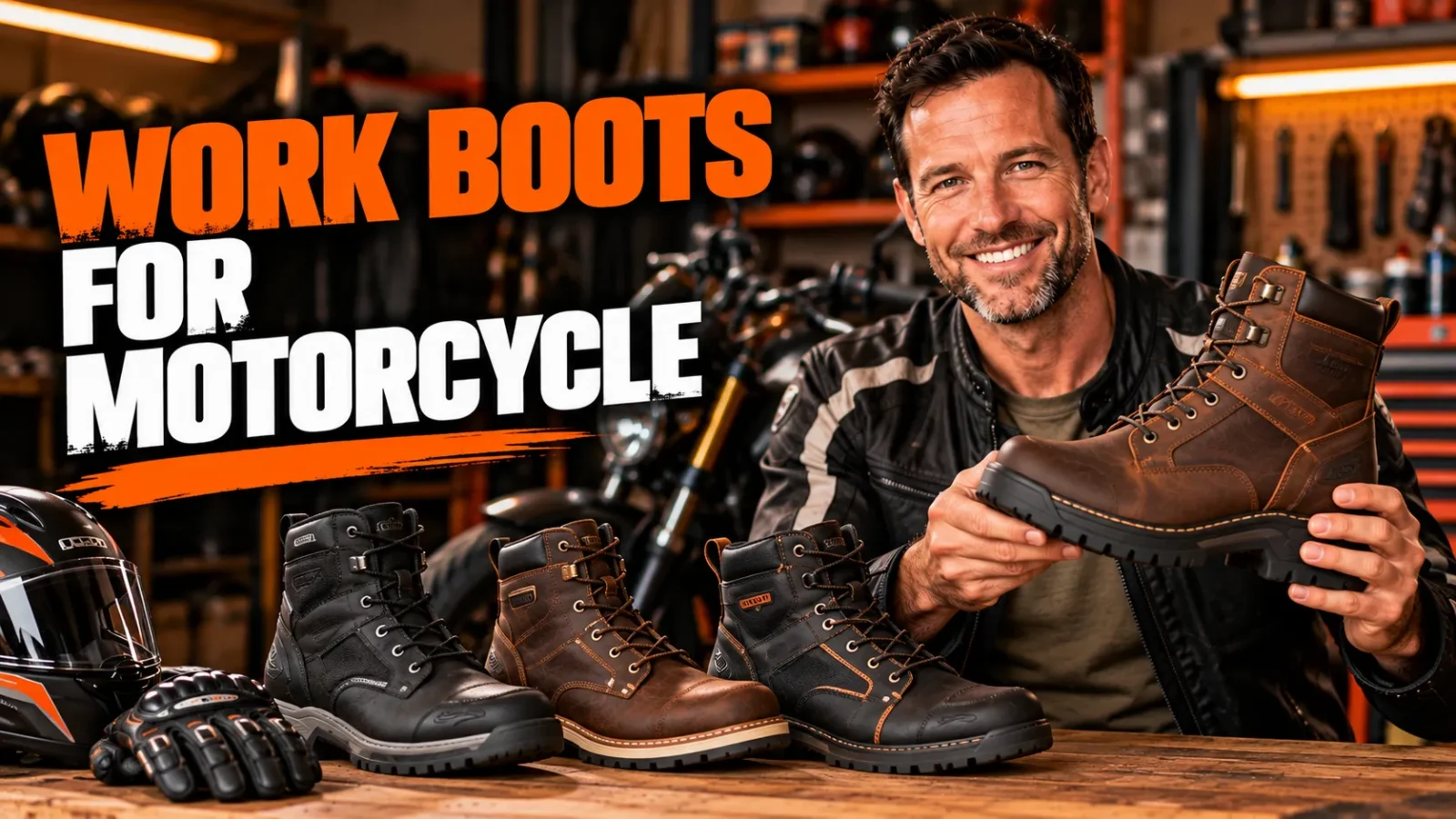
I’ve spent more mornings than I can count standing in my garage, staring at two pairs of boots, trying to decide which one gets me through a 9-hour shift and a 40-minute ride home. For a long time, I switched boots at the door like a maniac. Then I got smart about it.
These days, I ride to job sites in boots that do double duty: steel or composite toe protection for the workday, and enough ankle support and grip to keep me upright when I’m leaned over on the freeway. It took me years of trial, error, and a couple of blown-out soles to land on a shortlist I actually trust.
If you want the full breakdown of what separates a true motorcycle boot from everything else, I’d start with my Ultimate Guide to Motorcycle Boots. But if you need something that works a job site by day and handles a commute by bike, this list is for you.
- My overall favorite is the Thorogood 1957 Series Moc Toe, it balances comfort, durability, and enough ankle coverage for safe shifting and braking.
- If you want a boot built specifically with riders in mind, the Harley-Davidson Bonneville and TCX Blend 2 WP blend real work-boot toughness with motorcycle-specific features.
- Waterproofing matters more than people think, boots like the Danner Bull Run Moc Toe keep your feet dry in both a downpour and a puddle at the job site.
- A true work-and-ride boot needs oil-resistant, low-profile soles so they don’t snag your shifter, plus at least 6 inches of ankle coverage.
- Not every “work boot” is safe to ride in, I break down the real differences in my motorcycle boots vs work boots comparison.
1. Thorogood 1957 Series Moc Toe — Best Overall Work-and-Ride Boot
I’ve owned three pairs of the Thorogood 1957 Series Moc Toe over the years, and I keep coming back to them. They’re made in the USA with full-grain leather uppers and a Vibrator 430 outsole that’s oil, slip, and heat resistant, exactly what I need on a job site.
On the bike, the 6-inch height gives my ankles just enough support without feeling stiff on the shifter. The moc-toe construction means there’s no hard seam digging into my foot after eight hours of standing and then another hour of riding.
They run around $220-$240, which sounds steep until you realize mine lasted almost three years of daily use. Break-in takes about a week, so don’t expect comfort on day one. Once they’re worn in, though, they’re genuinely one of the most versatile boots I’ve tested for this exact use case.
2. Red Wing Heritage Iron Ranger — Best Iconic Leather Boot
The Red Wing Iron Ranger isn’t marketed as a motorcycle boot, but riders have been wearing them for decades, and I get why. The Amber Harness leather is thick enough to handle real abrasion, and the boot holds its shape better than almost anything else I’ve owned.
I like that the toe cap is reinforced without being a full steel-toe, so I still get some foot flex when I’m working the rear brake. The Goodyear welt construction also means these can be resoled instead of replaced, which matters if you’re spending $300-$330 on a pair.
They’re not waterproof out of the box, so I treat mine with leather conditioner every few months. If you’re deciding between a fashion-forward option and something more functional, I’d point you toward my Best Motorcycle Boots for Beginners guide for context on what new riders should prioritize first.
3. Danner Bull Run Moc Toe — Best Waterproof Option
Rain is the one thing that ruins both a workday and a ride, and the Danner Bull Run Moc Toe is the boot I reach for when the forecast looks ugly. It uses a full-grain waterproof leather upper with a sealed construction that’s actually kept my feet dry through a two-hour downpour.
The Vibram outsole grips wet pavement and wet job-site gravel equally well, which isn’t something I can say for every boot on this list. At roughly $200, it’s priced fairly for what you get.
My only knock is that the sole is a bit stiffer than the Thorogood, so there’s a slightly longer adjustment period for finding your shift point. Once I dialed it in, though, it became my go-to for wet-weather commutes.
4. Harley-Davidson Bonneville — Best Motorcycle-Specific Work Boot
This is the one boot on this list actually designed by a motorcycle brand with a work-boot silhouette. The Harley-Davidson Bonneville has a full-grain leather upper, a composite safety toe rated to ASTM standards, and an oil-resistant rubber outsole built for both a garage floor and a foot peg.
I appreciate that Harley-Davidson clearly designed this with riders in mind, the toe box has enough clearance for a natural shift motion, and the heel is shaped to hook onto a peg securely. It retails for around $180-$200, which is competitive for a safety-toe boot with this level of detail.
If you’re weighing whether a purpose-built moto boot beats a standard job-site boot, this model is a good real-world example of a boot that never forces you to choose. For a deeper dive into what “best” actually means for different riding styles, check out what are the best boots for motorcycle riding.
5. TCX Blend 2 WP — Best Hybrid Moto-Casual Boot
The TCX Blend 2 WP is technically marketed as a casual motorcycle boot, but I’ve worn mine on light work duty too, think warehouse shifts or delivery routes where you’re not dealing with heavy machinery. It has a waterproof membrane, a reinforced heel and toe, and a low-profile sole that doesn’t catch on my shifter at all.
What sold me on the Blend 2 is how normal it looks. Nobody at the office questions these as “motorcycle boots,” but underneath the leather there’s genuine impact protection built into the ankle and heel area.
At around $170, it’s one of the more affordable options here, and it’s noticeably lighter than the traditional leather work boots on this list. If your job doesn’t require a hard safety toe, this is a fantastic everyday crossover.
6. Icon 1000 El Bajo 2 — Best Casual Riding-to-Work Crossover
I picked up the Icon 1000 El Bajo 2 because I wanted something that looked less “biker” and more “guy who happens to ride a bike to the office.” The leather upper is treated for abrasion resistance, and there’s a hidden ankle protection system that you’d never guess is there from the outside.
The sole is a rubber compound with decent grip, though I’ll admit it’s not quite as aggressive as a true work boot. That’s fine for me since I use these mostly for commuting and lighter job-site tasks rather than construction work.
Priced around $200, the El Bajo 2 sits right in the middle of this list, not the cheapest, not the most protective, but a genuinely comfortable middle ground I still reach for a few times a week.
7. Bates Men’s Ranger Hot Weather — Best Lightweight Pick
Summer riding and working in heavy leather boots is miserable, and that’s exactly the problem the Bates Men’s Ranger Hot Weather solves. It uses a breathable nylon and leather combination that keeps my feet noticeably cooler on long shifts and hot afternoon rides.
Despite the lighter materials, it still has a durable outsole with solid traction, and the ankle height gives me the coverage I want for shifting and braking safely. At about $110-$130, it’s also one of the most budget-friendly options on this list.
I wouldn’t recommend this one for heavy-duty construction work since it lacks a hardened toe, but for warehouse work, light trades, or just a hot-weather commuter boot, I’ve had zero complaints after a full season of use.
8. Chippewa 1901 Wedge Sole — Best for Grip and All-Day Comfort
The Chippewa 1901 Wedge Sole uses, unsurprisingly, a wedge sole design instead of a traditional heeled outsole. I was skeptical at first because I associate wedge soles with less pedal feel, but on my bike it actually gave me more consistent grip on wet pegs.
The leather is full-grain and thick, built to survive years of scuffing against a frame or crash bar. Comfort-wise, this is one of the best all-day boots I’ve tested, the cushioned footbed makes a real difference after 10 hours combining work and a ride.
Expect to pay around $200-$230. If you spend a lot of time standing at work and then commuting afterward, the extra comfort investment pays off fast. This is also a solid pick if you’re transitioning from off-road work into more adventure-style riding, and it pairs nicely with insights from my Best Motorcycle Boots for Adventure Riding guide.
9. Rokker City Boots — Best Style-Forward Option
I’ll admit the Rokker City Boots caught my eye first because they don’t look like typical motorcycle gear or typical work boots, they split the difference into something closer to a rugged casual boot. Underneath the leather, though, there’s genuine reinforced ankle protection and an abrasion-resistant construction built for riders.
The sole has enough grip for warehouse or light job-site work, though I wouldn’t put these up against a full steel-toe boot for heavy construction. What they excel at is being a boot you can wear into a client meeting, then ride home in without changing.
Priced around $270-$300, they’re on the pricier end of this list, but the styling and build quality justify it for riders who want something that doesn’t scream “safety boot.” I’ve had mine for over a year and the leather has aged beautifully.
What I Actually Look for Before Buying
Sole grip and shape matter more than people think
I learned this the hard way with a boot that had an overly aggressive lugged sole, it kept catching on my shifter linkage. Now I always check that the sole is low-profile enough to move freely between gears.
Ankle coverage isn’t optional for me anymore
Every boot on this list gives at least 6 inches of ankle coverage. After a minor slide years ago where a low-cut boot did nothing to protect my ankle, I won’t ride in anything shorter.
Waterproofing saves both your feet and your boots
Wet leather breaks down faster and feels miserable on a ride home. I prioritize waterproof membranes or treated leather any time I’m buying a new pair, especially living somewhere with unpredictable weather.
Toe protection depends on your actual job
If your workplace requires a certified safety toe, that narrows your options considerably. If not, I actually prefer a soft or composite toe for better shifter feel while riding.
Final Thoughts From My Own Garage
I’ve cycled through more boots than I’d like to admit trying to find the right balance between job-site durability and real motorcycle safety. My honest answer is that there’s no single “best” pick, it depends on whether you need a certified safety toe, how much weather you’re dealing with, and how far you’re riding each day.
My personal daily rotation right now is the Thorogood 1957 Series Moc Toe for most days and the Danner Bull Run Moc Toe when rain is in the forecast. Both have earned their spot through actual use, not just spec sheets.
Whatever you choose, don’t skip the ankle coverage or the sole check, and once you’ve picked a pair, keep them maintained properly so they last. My guide on how to clean motorcycle boots will help you get the most life out of whichever pair ends up in your garage.
Frequently Asked Questions
Can I legally and safely ride a motorcycle in work boots?
Yes, as long as the boots cover your ankle, have a sturdy sole, and don’t have loose laces or pull-tabs that could snag on your controls. That said, dedicated motorcycle boots offer better ankle armor and abrasion resistance, as I explain in my motorcycle boots vs work boots comparison.
What makes a work boot suitable for riding a motorcycle?
Look for a boot with a low-profile, non-aggressive tread (so it doesn’t catch on your shifter), a heel that can hook a peg, oil-resistant soles, and at least six inches of ankle coverage for support in a slide or fall.
Are steel-toe boots safe for motorcycle riding?
Steel toes are fine and even beneficial for impact protection, but composite or soft toes tend to flex more naturally with your foot on the shifter, which I personally prefer for daily commuting.
How often should I replace my work-slash-riding boots?
I typically get 12-18 months out of a daily-worn pair before the sole grip degrades. Keeping them clean helps them last longer, check out my guide on how to clean motorcycle boots for a proper maintenance routine.

Related Articles

9 Best Cowboy Boots for Motorcycle Riding You Can Actually Ride and Walk In
I break down the 9 best cowboy boots for motorcycle riding, covering heel height, shifter wear, ankle support, and comfort…
Jake Miller
11 min read

9 Best Motorcycle Boots for Hiking That Actually Work Off the Bike
I tested and researched the top hybrid motorcycle boots for hiking. Here are 9 real picks that protect on the…
Jake Miller
11 min read

9 Best Non-Motorcycle Boots for Cruisers That Still Ride Right
Not into moto-specific boots? I break down 9 real, non-motorcycle boots that hold up on cruisers—tough leather, good grip, and…
Jake Miller
13 min read