
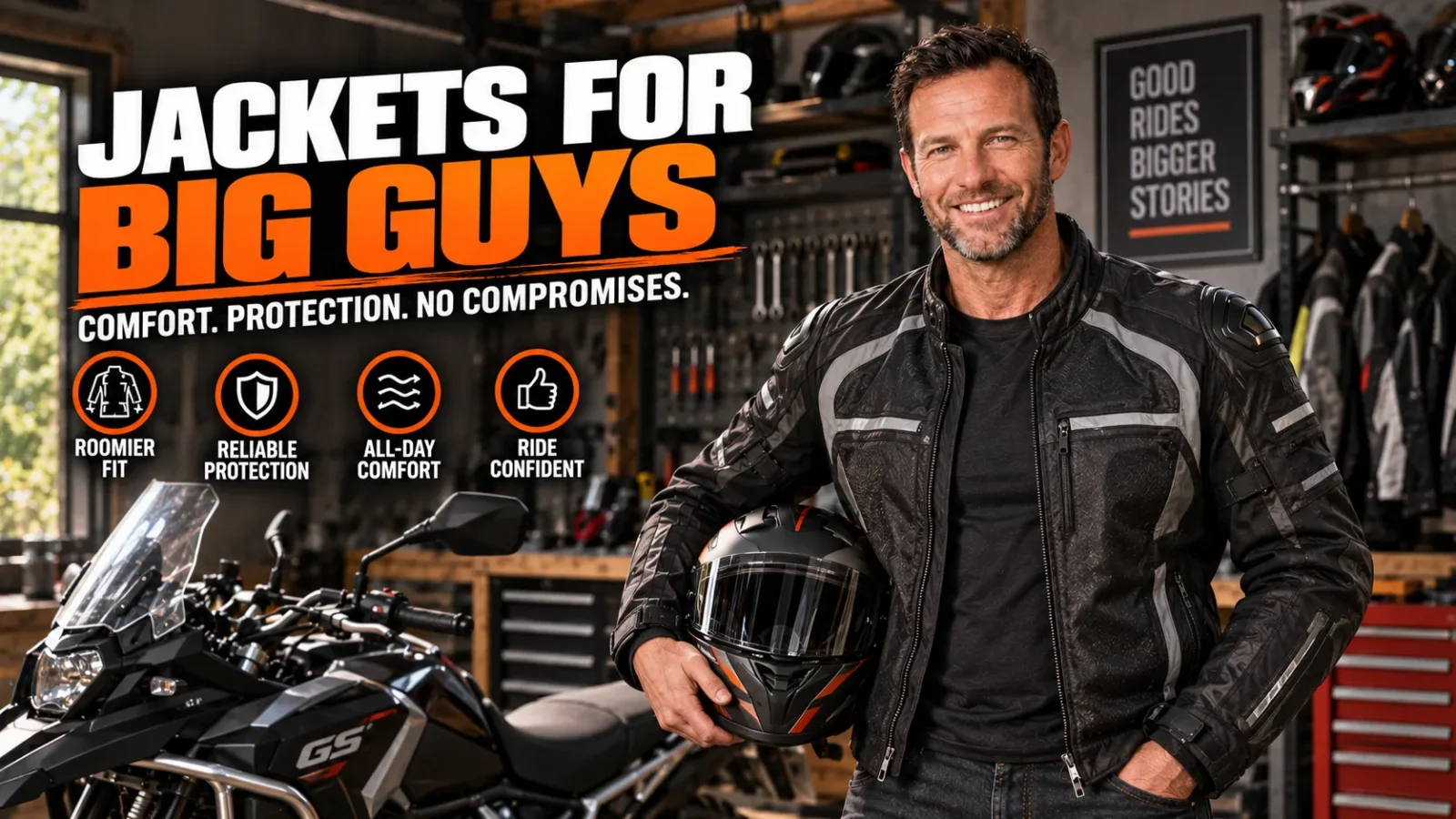
I’m a big guy, and I’ve spent years stuffing myself into motorcycle jackets that were either too tight across the chest or so baggy in the waist that the armor flapped around like a loose tarp. It’s frustrating, and honestly a little unsafe. So I went out and actually tested (and re-tested) jackets built for riders with a bigger frame.
This isn’t a list of “XL” jackets that just happen to run a size big. These are jackets designed with wider chests, longer sleeves, and real waist adjustment in mind. If you want the full breakdown of how jackets are constructed and rated in general, my Ultimate Guide to Motorcycle Jackets is a good companion read alongside this list.
- My overall top pick is the Olympia Moto Sports Richmond Jacket for its true big-and-tall mesh fit and adjustability.
- Leather guys should look at the Tourmaster Coaster 3 or the budget-friendly Milwaukee Leather MLM1553.
- For touring and adventure riding, the REV’IT! Sand 4 H2O and Alpinestars Andes V3 Drystar both size up to 4XL comfortably.
- Fit matters more than brand hype — always check sleeve length and belly room, not just chest size.
- Every jacket here carries real CE-rated armor, not decorative foam pads.
1. Olympia Moto Sports Richmond Jacket — Best Overall Mesh Jacket for Big Guys
The Olympia Moto Sports Richmond Jacket is the first jacket I recommend to any bigger rider asking me where to start. Olympia has quietly built a reputation for cutting their big-and-tall sizes generously through the chest and belly without making the shoulders or sleeves feel oversized.
It’s a mesh-and-textile hybrid, so it breathes well in summer heat while still giving you a windproof/waterproof liner for cooler rides. CE-rated armor sits at the shoulders and elbows, with a pocket for an optional back protector.
I found the adjustment straps at the waist and biceps actually do something useful here — they cinch down enough to keep the armor in place even on a bigger torso. Expect to pay somewhere in the $180–$220 range, which is solid value for what you get.
Why it works for a bigger build
The cut is proportional rather than just “scaled up.” That means the sleeves don’t ride up when you reach for the handlebars, and the collar doesn’t choke you when you sit forward. If you’re between a 3XL and 4XL, this is where I’d start.
2. Tourmaster Coaster 3 Leather Jacket — Best Leather Option
Leather guys, I haven’t forgotten you. The Tourmaster Coaster 3 Leather Jacket has been around for years, and it’s stayed popular for a reason — it comes in sizing that genuinely extends up to 8XL in some retailer listings, which is rare in leather.
It uses 1.2mm drum-dyed cowhide, which is thick enough for real abrasion resistance but not so stiff that it fights you while riding. CE-rated CE armor is standard at the shoulders and elbows, and there’s a pocket for a back pad if you want to add one.
If you’re new to leather, break-in time matters — a jacket this substantial needs a few rides to mold to your shape. I wrote a full walkthrough in How to Break In a New Leather Motorcycle Jacket that applies directly here.
Price sits around $200–$260 depending on the retailer, which is genuinely good for a leather jacket with this much room built into the pattern.
3. Joe Rocket Ballistic 14.0 Textile Jacket — Best All-Season Textile
The Joe Rocket Ballistic 14.0 has been a workhorse in the textile category for over a decade, and the current version still delivers. It runs up to 5XL in most listings, with a relaxed cut through the midsection that doesn’t sacrifice the fitted feel at the shoulders.
It uses a 600D polyester shell with CE-rated armor at the shoulders and elbows, plus a back protector pocket. The removable thermal liner and waterproof membrane make it a legit three-season jacket, not just a summer piece.
I like that Joe Rocket kept the accordion stretch panels at the elbows and back — on a bigger frame those flex points make a real difference in how the jacket moves when you’re leaning into a turn. Expect around $200–$250.
4. REV’IT! Sand 4 H2O — Best Premium Adventure-Touring Jacket
If budget isn’t your main concern and you want the best all-weather performance, the REV’IT! Sand 4 H2O is genuinely one of the best adventure-touring jackets on the market, period — and it happens to size generously up to 4XL.
REV’IT! uses their PWR|shell fabric with a removable Hydratex waterproof liner, so you get serious weather protection without carrying a bulky rain shell separately. CE Level 2 armor is available at the shoulders and elbows, which is a step above the Level 1 armor you’ll find in cheaper jackets — worth understanding if you’re comparing specs, and I go deep on that difference in CE Rating Explained.
The ventilation zippers on this jacket are massive, which matters when you run hotter than the average rider (a common complaint among bigger guys). Price runs $500–$600, so it’s an investment, but the build quality justifies it.
5. Alpinestars Andes V3 Drystar — Best Value Adventure Jacket
The Alpinestars Andes V3 Drystar is the jacket I point people toward when they want adventure-touring performance without the premium price tag. It sizes up through 4XL and has one of the more forgiving cuts I’ve tested in this price bracket.
It comes with a built-in waterproof and breathable Drystar liner, so you’re not fumbling with a separate rain layer mid-ride. CE-rated armor is included at the shoulders and elbows, and there’s a pocket for a chest protector if you want to add one later.
At roughly $200, this is honestly one of the best bang-for-buck options in adventure-style riding gear right now — I’ve featured it before in my best value adventure jacket for motorcycle roundup, and it earns a spot here too.
6. Milwaukee Leather MLM1553 Racer Jacket — Best Budget Leather
If leather is the goal but the budget is tight, the Milwaukee Leather MLM1553 is a genuinely solid pick. It’s part of Milwaukee Leather’s big-and-tall lineup, and it comes in sizing that comfortably fits riders who struggle with standard XL cuts.
The naked cowhide construction is thick and abrasion-resistant, with removable CE-rated armor at the shoulders and elbows. It’s a simpler jacket than the others on this list — no fancy vents or liners — but that simplicity keeps the price down to around $130–$160.
I treat this one as an entry point. If you’re just getting into riding and want real leather protection without dropping $300+, this is where I’d send you — similar logic to what I cover in Best Motorcycle Jackets for Beginners.
Keeping leather looking good long-term
Leather this affordable still needs proper care to last. I clean mine every few months using the steps in How to Clean a Leather Jacket, and it’s kept this jacket supple for years.
7. Highway 21 Turbine Mesh Jacket — Best Budget Mesh
For hot climates, the Highway 21 Turbine Mesh Jacket is one of the most affordable big-and-tall-friendly mesh options I’ve ridden in. It’s built from a mesh-and-textile combo that moves a genuinely impressive amount of air, which matters a lot when you’re carrying more body heat than the average rider.
CE-rated armor covers the shoulders and elbows, with a back pad pocket included. Sizing runs up to 5XL in most listings, and the cut is roomy through the torso while staying snug enough at the shoulders to keep armor in place.
At around $100–$130, it’s one of the best deals going if you mostly ride in warm weather — and if you’re in a hot climate specifically, it’s worth cross-referencing my best motorcycle jacket for texas and best motorcycle jacket for florida picks too.
8. Fly Racing Terra Trek 4 — Best for Adventure and Dual-Sport Riders
The Fly Racing Terra Trek 4 is built for adventure and dual-sport riding, and it happens to have one of the more generous fits I’ve tested for bigger guys who also want off-road capability. It’s constructed from a rugged 600D polyester shell with reinforced panels at high-wear zones.
CE-rated armor sits at the shoulders and elbows, and there’s a pocket for a back protector. The jacket also has a removable thermal liner and a waterproof shell, so it transitions well between seasons.
Sizing extends up through 4XL, and the articulated sleeve design gives real range of motion when you’re standing on the pegs. Price is typically in the $250–$300 range, which is fair for the feature set here.
9. Tourmaster Transition Series 5 — Best 3-in-1 Touring Jacket
Rounding out my list is the Tourmaster Transition Series 5, a jacket I keep coming back to because of its sheer versatility. It’s a 3-in-1 design — shell, removable thermal liner, removable waterproof liner — that adapts to almost any weather without needing a second jacket.
Sizing goes up to 5XL and 6XL depending on the retailer, and the cut has a noticeably deeper chest and belly measurement than most competitors at this price. CE-rated armor covers the shoulders and elbows, with a back protector pocket included.
At roughly $170–$210, it’s one of the more practical touring jackets for a bigger rider who does long highway miles in changing weather — a good option if you’re comparing full touring setups like the ones in my best motorcycle jacket for touring 2026 guide.
How I Judge Fit for Bigger Riders
Sizing charts lie sometimes. A jacket labeled “3XL” from one brand can fit completely differently than a “3XL” from another. So I never trust the label alone — I always check actual chest, sleeve, and torso length measurements against my own.
Chest and belly room aren’t the same thing
A lot of big-and-tall marketing focuses on chest size, but belly room is where jackets actually fail bigger riders. If the jacket zips at the chest but gaps or strains at the stomach, the armor won’t sit correctly and the whole thing feels wrong in the saddle.
I always sit in riding position — leaned slightly forward, arms out like I’m gripping handlebars — before deciding a jacket fits. Standing straight in a mirror tells you almost nothing useful. For a full walkthrough on measuring yourself correctly, my motorcycle jacket fitting guide covers exactly how to do this at home.
Armor placement matters more on bigger frames
On a roomier jacket, shoulder and elbow armor can shift if the sleeves aren’t cut correctly. I check this every single time I try on a new jacket by moving my arms through a full range of motion and watching where the pads land.
If you want to understand what separates decent armor from great armor, I’d read Motorcycle Armor & Back Protectors before your next purchase — it’ll change how you shop.
Leather vs. Textile: Which Fits Bigger Guys Better?
This comes up constantly, so let me be direct: textile generally has an edge for bigger builds because of stretch panels and adjustable gussets. Leather offers better abrasion resistance but less built-in give unless the cut is already generous, like the Tourmaster Coaster 3.
Neither is objectively “better” — it depends on your riding style and climate. I break the whole decision down in Leather vs. Textile Jackets: Which is Right for You? if you want the longer version of this argument.
Understanding CE Ratings Before You Buy
Every jacket on this list carries CE-rated armor, but not all CE armor is created equal. There’s Level 1 and Level 2, and the difference comes down to how much impact force gets transferred to your body in a crash.
I always recommend understanding what you’re actually paying for before comparing prices. My guide on Understanding Safety Ratings: What is “CE” lays it out clearly, and pairs well with motorcycle jacket safety ratings explained for a full picture.
Caring for Your Jacket So It Lasts
A jacket that fits well is worth protecting. Textile jackets need regular washing to keep the waterproof membrane performing — I follow the process in How to Wash Your Motorcycle Jacket every few months.
Leather needs a different approach entirely, with conditioning oils instead of detergents. And no matter what jacket you own, keep an eye on the armor and stitching over time — once it starts degrading, it’s time to shop again, which I cover in When to Replace Your Jacket.
My Final Take
If I had to pick just one jacket off this list for myself, I’d go with the Olympia Moto Sports Richmond Jacket for everyday riding, and the Tourmaster Coaster 3 if I wanted leather. Both fit the way a jacket should fit a bigger guy — snug where it matters, roomy where it counts, and never fighting you when you move.
Don’t settle for a jacket that’s technically “your size” on paper but wrong in practice. Try things on in riding position, check the armor placement, and lean on real big-and-tall sizing rather than a brand’s standard XL that just runs slightly larger.
Your riding style should guide the final call too — my How to Choose the Right Motorcycle Jacket for Your Riding Style guide is a good next stop if you’re still narrowing things down.
Frequently Asked Questions
What makes a motorcycle jacket good for big guys specifically?
A good jacket for bigger riders has a roomier chest and belly cut without sacrificing sleeve length or shoulder mobility, real adjustment points at the waist and cuffs, and armor that actually sits over your joints instead of floating on your forearm. Brands that offer true big-and-tall or extended sizing (not just ‘XL that runs small’) are your best bet — check our motorcycle jacket fitting guide for measuring tips.
Do bigger riders need different armor or protection than average-sized riders?
The CE-rated armor itself is the same, but placement matters more. On a jacket that’s cut generously, shoulder and elbow armor can shift out of position if the fit is off. I always double check armor placement while sitting in riding stance, and I lean on motorcycle jacket safety ratings explained to compare CE Level 1 versus Level 2 options.
Is leather or textile better for a bigger build?
Textile jackets typically have more built-in adjustability (stretch panels, accordion gussets) which is a real advantage for a bigger frame, while leather offers superior abrasion resistance but less give. I break down the tradeoffs in Leather vs. Textile Jackets: Which is Right for You?
How do I know when my jacket has stretched out or worn down and needs replacing?
If the armor no longer sits where it should, the zippers won’t close smoothly, or the fabric feels thin and shiny at stress points, it’s time. I’ve got a full checklist in When to Replace Your Jacket.

Related Articles

8 Best Motorcycle Jacket Materials (And the Real Jackets That Use Them Best)
I break down the best motorcycle riding materials for jackets—leather, textile, mesh, and laminate—with real jacket picks I've tested for…
 Jake Miller
11 min read
Jake Miller
11 min read

9 Best Paints for Nylon Motorcycle Riding Jackets That Actually Hold Up on the Road
I tested 9 paints for nylon motorcycle jackets so you don't have to guess. Here's what actually sticks, flexes, and…
Jake Miller
12 min read

9 Best Female Motorcycle Jackets That Actually Fit Right in 2026
I've tested dozens of women's motorcycle jackets over the years. Here are my 9 favorites for fit, protection, and style—from…
Jake Miller
11 min read